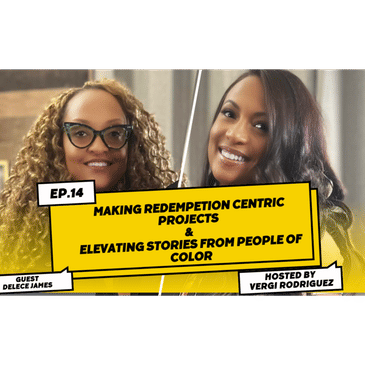
This week we talk to Executive Producer Delece James. Two decades as a Executive Producer and Development Executive. She worked on redemption-centric biopics "The First Lady of BMF: The Tonesa Welch Story.” Has worked with FOX and HBO. She is an advocate for philanthropy, lending her support to organizations like Delta Sigma Theta Sorority, Inc and Zawadi Cultural Collective. She wants to continue to amplify the stories of people of color, underscoring her commitment to driving fresh perspectives and inspiring meaningful change.
A Race Of Your Own
IG : / raceofyourown
Delece James
https://www.imdb.com/name/nm12539385/ / deleceonlife
Don't forget to subscribe.
Listen also on:
Spotify: https://open.spotify.com/show/3YOHILg...
Amazon Music : https://music.amazon.com/podcasts/0d4...
RSS FEED: https://rss.com/podcasts/araceofyourown/
[00:00:00] Hi, I'm Vergi Rodriguez and this is A Race Of Your Own where we talk about how inspiration leads to resilience. And today's guest I'm really excited to have because I've known her for a long time and she's amazing. Executive Producer, she has over two decades as an Executive Producer and Development Executive. She's worked on redemption centric biopics, which I love that phrase. The First Lady of BMF, the Tunisia, and I think I'm saying that right, wealth story, has worked with Fox and HBO.
[00:00:28] She's an advocate for philanthropy, lending her support to organizations like Delta Sigma Theta Sorority and Zawadi Cultural Collective. She wants to continue to amplify the stories of people of color, underscoring her commitment to driving fresh perspectives and inspiring meaningful change, Ms. Delece James. Hi. Welcome. Thank you. Yes. You make me sound so good. Because you are. Because you're amazing.
[00:00:57] Hello. Yeah. Hi. It's good to see you. Likewise. I know. It's been a minute. I know. And we started out as dancers in New York City together. We were doing our thing. Doing our thing. And here you are. Five, six, seven, eight. And here you are. I know. And here you are. I know. Proper Hollywood Executive Producer. Girl, it's been a journey.
[00:01:18] Please discuss. Divulge. So, I mean, your credits and what you do, you know, you also, I kind of want to start. Did I say that right? Tunisia? Is that right? It's Tunisia. Tunisia. Excuse me. Yeah. Okay. Tunisia Welsh story. You know, and I like redemption centric biopics. I love that. Yeah. Yeah. I love that. And so, I started out because I co-created and executive produced a series called American Gangster Trap Queens on BET Plus.
[00:01:45] Yes. And we tell the stories of women who've run criminal empires. And it runs the gamut. Everybody thinks it's just drugs. I've seen a couple episodes. It's not just drugs. Fascinating. Yeah. We tell white collar crime stories. We're like into healthcare fraud. We're like. You cover all of it. We cover everything. And so, as a result, some of the stories are really good. But you're only telling like, you're only covering like 42 minutes.
[00:02:10] Right. Right. In an episode. And so, some of the episodes have been so good and rated really well. And so, we've been turning them into feature films. That's amazing. Yeah. And so, we've done three so far. You've done three. Yeah. And I think I picked that one up just because I know a lot of people have talked about being that. People are obsessed. You know, they know that story. They're obsessed. Like, it hits home for a lot of people. Yeah. Because they just really know that story. Yep. And, you know, wanting to amplify stories of color and people of color, specifically even women of color.
[00:02:39] And I didn't even, there's, look, I try to get through everybody's credits. I know I didn't touch on all of them. And, you know, the American, the Trap Queen. Yeah. I've seen a couple of those. And I think that it's fascinating. And so, just kind of like, take us through what, you know, I talk a lot about being inspired, staying inspired, and then the resilience that comes with that.
[00:03:00] And because of the industry that you're in, shifting from something like being a dancer, being on the road, being whatever, and then moving into production. Yeah. Yeah. Right? And actually getting stuff placed and getting those stories heard. Yes. So, what have you found, because, and we'll dive into it too, because the industry is changing so much. And a lot of independent filmmaking and independent projects is what. It's necessary right now. It's kind of where it's going, right? Yeah. Or at least that's what we see. Yeah.
[00:03:29] Where do you feel for you, like, kind of when that pivot happened for you, right? Like going, being like, okay, I was a dancer. I love that. And you're still in the industry. But then you went and started producing. So, my story is a little different because I started out at HBO. Right. So, went to college. TV production was my major. I think at the time it was called something like electronic journalism. Like crazy. I know. I know. I know. I don't know who came up with that. Shout out to Hofstra.
[00:03:58] Shout out to Hofstra. And so, I worked after I graduated college. Got a job at HBO in New York. Worked there for three years. And so, hadn't thought about dancing. Never wanted to be a starving artist. Like, I was very anti that. Like, kudos to the people who were doing it. Shout out to my performers, sisters and brothers. But I was like, nah, I can't do it. Right.
[00:04:22] And so, after like my third year at HBO, I was getting a little disillusioned. Various reasons. I was like, is this my purpose? Is this what I'm supposed to be doing? I'm pouring my heart into it. I'm not seeing the results. What's next? Someone hipped me to like a network marketing company. Shout out to Tag Team Marketing. Shout out to Tag Team.
[00:04:45] Yeah. And that actually gave me the courage and the income to be able to leave that job at HBO and to start figuring out like who I am. I was 24. I was like, who am I? What do I want to do with my life? I'm going to hang out and do this network marketing thing for a while and we'll see what happens. And so, there was a point where somebody introduced me to Tony Robbins. Right. And they were like, we got to go to these Tony Robbins seminars. We got to get our personal growth together. I'm a young girl from the Bronx.
[00:05:14] Right. Grew up in an environment. We all know what that looks like. Shout out to the boogie down. So, we all know what that looks like. Right. We've heard it wasn't a great environment. My parents did a great job. I was loved all the things. But in terms of my mentality and having a positive mindset and a growth mindset, I did not have that. And so, going to Tony Robbins events, reading Les Brown's books, those things poured into me in a way that helped me to dream bigger than where I was.
[00:05:42] Tony had an event where he was like, write down everything you've ever wanted to do in your life. Don't judge yourself. Don't think about it. Just close your eyes and write. It was like one in the morning. We had been at the event for like 12 hours. I was dying. I can't. There's a lot of personal growth. Tony Robbins. I know. And I opened my eyes and the thing at the top of my list was to be an NBA dancer. And I had forgotten it was something I'd always wanted to do. Tony Robbins. Wait, did you dance for the NBA? Tony Robbins. I did. Tony Robbins. You did? Tony Robbins. Yes. Tony Robbins. Why didn't I know that? Tony Robbins. I know. Tony Robbins. Did I know that? Tony Robbins. I don't know. And so, I hadn't danced in years.
[00:06:12] Tony Robbins. Yeah. Tony Robbins. Went home. There was like a boot camp. The Knicks were having a boot camp. Did that. And then went on and did the audition and got the job. Tony Robbins. Nice. Crazy. Tony Robbins. Nick City Dancer? Tony Robbins. Yes. Tony Robbins. Nice. Tony Robbins. It was a crazy culture shock for me. And like everybody had danced forever. Tony Robbins. Yeah. Tony Robbins. It was trial by fire. It was hard as heck. I also had some like personal things happen in my life at the time that were like crazy. And so, it made that experience even harder.
[00:06:42] And so, I auditioned for the Nets the next year. And that environment, I really flourished in that environment. Tony Robbins. Like, I found my tribe, my dance tribe. I was there for a couple years. And through that, I was able to make a name for myself and start doing backup dancing. So, I was dancing for Alternate. Tony Robbins. Yes. Tony Robbins. And then Deborah Cox. Yes. Shout out Deborah Cox. Shout out Darren Henson. Shout out Jermaine Brown. Oh my gosh. All the Jermaine Brown. Oh my gosh.
[00:07:10] You know what I mean? Giving me my shots. Yes. So, Tony Robbins. Because I see you on, I see you at radio shows, at promo shows. Yes. And I think you were with Deborah at the time. Yes. And I was with Vitamin C. I remember that. And we'd always see each other backstage. It's crazy. I know. So, anyway, go ahead. Sorry.
[00:07:26] Yeah. And so, that, I did that for a while. And that brought me to LA. Because I was like, oh, I'm going back to New York all the time. Traveling to Europe. All these fabulous places. And I was like, oh, I need to change my environment. I'm trying to change my mindset. Right. It's not going to work unless I change my environment. Nice. And so, we did some shows in LA. And I was like, what is this place? I got so excited when I got off the plane. Yeah. I was like, what are these palm trees? The sunshine? It's so nice and warm.
[00:07:54] Everybody was smiling. Right. I was like, oh, that's different. And chill. That's different at home. Yeah. And so, I stacked my chips and moved. I think it was like within a year. Nice.
[00:08:03] And my family was so pissed. Devastated. Devastated. They were like, we don't do this. They're like, you're making a mistake. They were like, everyone in our family lives within like six blocks of each other. Oh. Yeah. Yeah. Is most of your family still in New York? Yes. Okay. I have some in Atlanta, too. Okay, cool. But yeah, mostly in New York. Okay. And so, I moved. It was great. But then, I was like, still doing some shows. Yeah. Traveling. Yeah. Right. And then, I was like, what am I doing with my life? I had a boyfriend at the time. I was struggling to keep that together.
[00:08:33] Because I was always away. Right. It's not as easy as it is now. Nope. And so, I was like, you know what? I'm going to go back to the other side of the camera. I was like, I'm going to do this. Nice. I remember there was a, I don't remember when it launched, but there was an HBO office in LA that had started, I think it launched when I was at HBO New York. Okay. So, I remember that. It was back when my memory was still really good. So, I called. Yeah. Bold. And I was like,
[00:09:03] At first, I called my old employers in New York. I was like, you guys still there? Great. I'm about to call this office in LA. Can I use you still as a reference? They were like, oh my God, we remember you. We love you. Blah, blah, blah, blah. And I'm like, awesome. So, I told a woman, Joy Brandt. Shout out to her. Shout out, Joy. She took, she heard, she took my call. She brought me in for a meeting like that week and put me in the tent pool that week. Nice. And so, from there, within like a month, I got a job. I think it was HBO, the comedy festival maybe.
[00:09:32] Was there for a year. That was also like one of the hardest jobs in my life. I worked for somebody who was like, Like this huge, like personality. But that was like, yo, it was tough. That was a tough job. Because I was all coming from this like warm, fuzzy environment, like independent. And he was a very challenging person to work for. Nice. Yeah.
[00:10:01] But it's in those moments, right? So, it sounds like for me, kind of hearing it back. It's about taking a risk, right? Yeah. But it's also about like having this confidence in yourself saying, I think I'm just going to reach out. I think I'm good enough. Yeah. To, and maybe that was a Tony Robbins thing, like that personal growth moment where you had, where you were like, I think I'm good enough. Yes. To at least reach out and be like, hey, I can, you know, I've worked here before. Yes. You know, you bet on yourself and you took that chance on yourself.
[00:10:28] When you found yourself kind of working with this next person that you're like, you're challenging. Yeah. Isn't that like a moment of growth though to? I didn't realize it at the time. Right. But it was, but I'd always heard that, you know, in this business, like people are going to force you to develop a tough skin. And I didn't have one at the time. My Knicks experience was that. Like I was like, oh my God, what is happening? Yeah.
[00:10:54] And so this job was very similar and I was like, oh my God, like, I guess I have to develop a tough skin. Yeah. In order to survive in this business if I really want to be in it. And I had to learn also that you have to learn when to say goodbye. And so I was lucky that the HBO environment was such a family environment and I was really loved there. And I was able to leave that position and get another position in a different department, which was HBO Films Production. Right. And that's where I was really at that time supposed to be.
[00:11:22] And so I was in that job for I think a little over two years and just soaked up Films Production. Like it was, I was a sponge and they were like, you are about this production life. And you're like, yeah. I see you as a production exec and all this stuff. And then, and then. Wait, what happened then? I decided I wanted to be in development. Because I had been reading scripts. Because when you're a production exec, you're reading scripts, you're looking at budgets, all that stuff. And I was like, oh, I love this creative part. Yeah.
[00:11:49] I love being able to kind of like read the script, but also like think about changes and character development and all of that. And so my boss at the time was like, what? What are you doing? What are you doing? But do you feel like looking back on all that, right? Because it sounds like in those moments, right? You're like going through it and you're like, what the heck is going on? Oh, yeah. But then now doing what you're doing now and doing these shows and doing this content, basically.
[00:12:17] Do you find yourself looking back and going, oh, I pulled this skill out of when I was there and I was doing that. And you're like, oh, I am well equipped. Because sometimes, I don't know, just even for me sometimes and I'm sure maybe for my viewers, like you find yourself in these moments where you're like, I don't know what I'm doing. Or, you know, you have to take a risk or you have to have that extra level of confidence. And then you tend to start to remember, oh, when I was working at HBO, you know, and I wanted to switch into development more or whatever.
[00:12:45] Or when I was working in production, I did that already. Yeah. Oh, that's that skill I learned, you know, and sometimes we're just we're more equipped than we know. It's true. Or we remember. It's true. Right. And so how do you find when you now from all of that experience, you find a project you want to work on? Do they come to you? Do you develop them? Do you search out? Does something give you an idea and you go, I want to do that? Or is it a mix of kind of both things? It's really all of that. Okay. It's really all of that.
[00:13:14] In my last position, I was running development for Judge Mathis, his production company. We had a deal at Warner. And so we developed all kinds of mostly unscripted content. Did you work with him one on one, like proper, like one on one? Oh, absolutely. Yeah, we were. It was him and me, basically. Okay. Like I had a part time assistant, but, you know, we're basically partners, right? Like, so he hired me to basically be an idea factory. Nice. Come up with ideas and execute them. Nice. That's what he needed.
[00:13:42] And does he do a lot of, he does a lot of, is it more like the legal, like in that legal kind of law, law and crime or like what is. So what's interesting is that people have known him for a long time because of the court show, right? Like he's been on, I think it's like 27 seasons or something at this point. Yeah, yeah, yeah. A long time. Yeah. A long time. And so our goal was to really expand his brand, which we did with American Gangster Trap Queens. And even like another show called Beyond the Pole, right?
[00:14:09] Like, which is about exotic dancers who want to get off the pole, but it's really about their redemption journey. Right. And like redefining themselves and female empowerment. Yeah. And so he really is a reason why I started to focus on these redemption stories about women. Like I've always been fascinated by female stories, right? Right. But I never thought about the redemption part until we started talking and he told me about
[00:14:36] his own personal journey from gang to gavel. Hmm. I didn't know that about him. Yes. I didn't know his story. I knew he had done stuff in a new show, obviously, because it's been on for a long time. Oh, yeah. I didn't know that. He grew up as a tough street youth in Detroit. Yep. I didn't know that. Oh, yeah. Yeah. And then like went on, got his GED. I want to talk to him. Yeah. Can we get him on the show? Okay. Anyway. We can ask. We can talk later. He's super busy saving the world. Sounds like it.
[00:15:05] But see, it's people like that that are fascinating, right? And then again, back to sure, when you work with HBO, people like that must rub off on you, right? Yeah. Where you're saying, yes, I want these redemption stories. And we're seeing a lot of that now. Yeah. Right. We're seeing that the narrative is like kind of this empowerment stuff and how important that is to a lot of people. Yeah. Because it's like we can't discount people because they've made mistakes. Right. Right. And I think that's the part that is always challenging, you know, in everyday life. Right.
[00:15:34] People want things to look perfect. Right. People want to be perfect. Right. And it's like, why do we put that pressure on each other? Right. Why do we put that pressure on ourselves? Right. Like I've been fired from jobs. Yeah. But people are like, you can't talk about it. Because it's a stigma. It's a scarlet letter. You'll never get hired again. Oh, we'll talk about being blackballed in this industry, which is a whole other episode. I mean.
[00:16:01] But we're here now, you know, and I find that I'm going to go down. I'm going to go down the hole. Go down the rabbit hole. But a little bit. But I feel like as women, women of color, very educated. We have our degrees. We're very smart. We are independent. We have our friends, our family, et cetera. We just have lives. Yep. Right. Full lives. Full lives.
[00:16:29] One thing I've learned being in the industry, and I love the industry. I love being creative. I think that's why you're in it too. You don't do this because it's like, sure, there might be a payoff. And sure, you might do some really cool stuff. I love it. And like, but it's not about, it's not really about the money. Yes, I want to get paid for my work. But, and I do have gripes because it's like, I've even witnessed or even just for myself experienced online sharing something. And then, you know, you see somebody else do it with a bigger platform or with more money. And you're like, wait a second.
[00:16:58] And then you see them lift something else. And then you're like, wait a second. You know what I mean? And so what I've learned in the industry, unfortunately, is you can have all the things. You can be really pretty. You can be, you can be really funny. You can be, you know, lively and whatever. Don't be smart. Don't be smart. And when you are smart and you show that you are smart as a woman, woman of color. Yeah. It's held against you. Yep. And that sucks, right?
[00:17:27] It does suck. So finding and seeing what you're doing and you're doing it on your own and you're moving the needle in that sense. And then you work with someone like Judge Mathis who is saying, no, I want these redemption stories. I want to tell the other side. It's inspiring. A thousand percent. It's inspiring to know that there's a man at that level saying, I want to tell these stories. I want you to help me. Yeah. Here. Come here. And is not threatened by your smartness. Right. Is actually saying, I'm encouraging it. That's right. I'm encouraging you, Delise.
[00:17:57] I see something in you and I'm not threatened by that. That's right. He turned his life around and I don't know too much of his story, but what you just told me. So it's like inspiring you. Like, not that you needed to turn your life around. Don't we all. Don't we all. But, but you, he saw something in you. Yeah. And was in, and it wanted to encourage that in you and say, I want to lift you. Hey, look, I got this story. I got these stories. I want to tell these stories. And you're probably like, oh, hey, what about this?
[00:18:26] And then it inspires you to be like, what about this? What about that? Even if it sucks. Even if he, I'm sure there were maybe moments he was like, never know. But you were still like, that's okay. Because he's still encouraging you. He's still giving you kind of this platform. And so I'll get off my soapbox now. No, it's all good. But I, but I feel like it's all good stuff. You know, when you're talking about this, it's great to hear that there's people like him in that place. You know, a black man turned his life around, came back and was like, Hey, yeah, come on board.
[00:18:56] I see something in you. Come work for me. Come. And we don't hear that a lot on my soapbox a little bit. No, it's all good. But you know, what would you say to, to women, especially young women? And I always, you know, that are just out of college or just, you know, that are saying that are like, I don't even know. Cause the business is changing. The industry is changing as we speak. It has changed. You know, and I don't want to, I hate asking, where do you think the industry is going? I know. Because we both kind of work independent in that sense.
[00:19:24] And you work in them and you showcase that just through, I didn't even say nominated for two men and, and double ACP image awards in 2024. Yeah. I didn't say that. Right. And you have an award-winning short film called devil ain't pious. Yeah. Which I want to kind of go down that, you know, down that road as well. But you know, I would say that right now it's important to lean into what you're passionate about. Right.
[00:19:51] You know, because the business is changing so much and it's changing. We don't know where it's going. Right. What we do know is that companies are hiring less people. Yep. They're doing a lot more production overseas. Right. And so they're asking a lot of people to wear a lot of hats. And so if you're being forced to wear a lot of hats, no matter where you are. Quit. No, I'm kidding. You should really enjoy what you're doing. Right. Yeah.
[00:20:18] If you're going to be working yourself to the bone, you should at least love the content, the area of the business, whatever it is that you're in because you're going to be working your butt off. Do you feel like maybe Newsom just came out and said, you know, he might have a tax incentive for California. We don't really know what that plan looks like. Like, do you think that would help at least specifically here in Los Angeles? Because we're here. I mean, if it's competitive. Right. Right.
[00:20:45] And so a lot of people are optimistic about it and saying that it could move the needle. Yeah. But we just have to wait and see. Yeah. Right. Companies are, especially since the strike happened, you know, there are a lot of ramifications to that. And I'm excited that we continue to fight for our rights. Yeah. But we also have to understand that there are consequences per these big companies that they
[00:21:13] are going to make us pay in other ways. Right. And do you feel how strong of a stronghold? What do you think AI has on a lot of this? Yeah. I mean, I keep hearing, you know, AI, AI, AI all day. And I think it's a blessing and a curse. Right. Like it's giving me taking away. Right. Because I'll use chat GP. Yeah. Yeah. Absolutely.
[00:21:39] As we are being asked to do more and wear more hats, AI is helpful. Right. That like that with that. Right. Like it's a great assistant. Right. It's like I need to know, you know, how many movies were nominated for this? Right. Like and it can be like it'll run it down. But in terms of like creating decks and stuff, which is what I do and it's part of my job in development. I don't want AI to take that. Right. Because that's part of what I do.
[00:22:07] And as a consultant, which I am now. Yeah. Right. To different companies. I want to be able to continue to market market that as a service I provide. Right. That makes what I do unique. Right. Over AI. But also it's kind of like it's niche to like, let's say you're creating a deck or something about whatever the shows are, whatever, you know, there's going to be probably information that might not be that AI can't get to because it's niche to to what, you know, like, you know,
[00:22:36] maybe specific data or, you know, something about the story. Yeah. That was never written anywhere else or something. So that's there is this human touch that I feel like can't be taken away and can't be replicated or replaced in that sense, you know. And, you know, another thing, too. And I think it's, again, these redemption stories and what you were talking about, you know, how important do you feel like it is that we tell our stories from our perspectives? Right.
[00:23:05] That or we help tell our stories. Yeah. Right. Do you feel like that's, you know, because again, and I've talked to you about this and you've seen, you know, we both have worked on short films and, you know, getting that immediate feedback about something that you're passionate about, you know, is so important because sometimes, again, viewers that are out there that might be thinking like, well, I want to work on something. I just I've never shot anything. Yeah. And we have our phones now.
[00:23:35] We can shoot anything on our phones, even 4K on our phones. Right. Magical. So what would you say to those filmmakers that are like, but I have nothing to say, but I want to do it. Right. The importance of like there's got to be something in your story. Yeah. You know, about you being a dancer and then you going to corporate and then being like, well, I think I'm going to go back to being creative. You know, there's something fun about that or somebody would resonate with it. Right. Yeah. Like how important do you feel that is?
[00:24:01] I think it's really important for us to tell our stories for like multiple reasons. Right. And I think sometimes people also, when we talk about telling our stories, they have to recognize that not all people of color are the same. Right. And so you may want to tell a specific story about a young girl from the Bronx who like becomes a dancer and then a TV exec.
[00:24:28] But the person from, let's say, I don't know, the black person from Omaha, Nebraska, wherever, someplace like other than a big city in the country can't tell my story because they didn't grow up in my environment in the South Bronx dealing with all the things that I was dealing with and in a family with the parents that I had. Right. It was like all of these things. It's very unique to you. That are layers that color who I am.
[00:24:56] And so I think it's important for people who are whatever environment or world or city they live in, they should figure out what is important and what they think. Not important, but what they think is what they think would resonate with people in crafting what their story would be, whether that's documentary or a scripted series, feature film or even a novel. Yeah. Yeah.
[00:25:23] And I just I feel like sometimes people get so caught up. Well, I've never done that. I've never written a book. Yes. I've never. Yes. Whatever. I say that. Yeah. Yeah. I say that. Well, I've never done that. I say that. Yeah. But there's so much access now with not even just like Google, right? The Internet. What do you think of Tubi? I love it. You just jump in. I love you. I have good thoughts about Tubi. Because you said that. I have good thoughts. There's so much access. I have good thoughts about Tubi.
[00:25:52] And I just thought of Tubi and so many people are like, oh, my film's up on Tubi. And I'm like, that's great. I celebrate anybody who has a film on a platform. That's a big deal. Right. Right. Coming where we and most of the people who have those films on Tubi are coming from a place where they never made films before. Right. Right. Or never thought they could make films, even if they've made a few. They never thought that they could be in that position. So kudos to Tubi for giving people that shot. Right.
[00:26:19] And also creating a rev share model that's attractive to filmmakers. Right. And creators. Right. How dope is that? So do you feel like, I'm just like, tell me all your thoughts. It's okay. And so also I think that people should just get out of their comfort zone. Stop focusing on what you can't do and figure out what you want to do. Right. And then put the things in place that you need to, to do it. Right.
[00:26:47] Whether that's bringing people you know who know things, read some books, go to some seminars. There's no shortage of information out there. Right. You just have to take the first step. And it doesn't have to be perfect. I think that's something also that like, tying back to what I said earlier, we've all been built, especially people of color. We have been charged with being perfect all of the time. We can't have a misstep. Nope. You have a misstep. You'll never make it.
[00:27:14] But you still have to kind of like, for lack of a better phrase. Yes. It's true. Like we got to play smaller. Right. But still be perfect. And still be perfect. And whatever that role is, it's a lesser role that they want you to have. But it has to be perfect. Right. Don't mess up. And that is exhausting. Yes. And impossible. That's an impossible mark to hit. Yeah. And so you have to just start. You have to just start and try. You have to start being perfect.
[00:27:44] Stop trying to be perfect and just start. You know what I mean? Who cares if it's not right or if your lighting's not right or the sound's not right at first? Just try. Right. If you don't know how to write, read a book. Right. Read a bunch of books. Figure out what the format is. Right. And you'd be surprised, like what I find too, with social media and the power of social media. How, like I keep coming back to this, but it's like once I realized who I was inspiring,
[00:28:13] once I realized who was coming to watch my stuff. Yeah. And be inspired by that. I was like, well then if we should be more inspiring, more than anything to go, well then I need to keep going. Then I need to, why would I stop? No matter what they say, no matter what they do, no matter how they come at you. Yeah. It's even more empowering to be like, but we do doubt ourselves. We do because whenever, oh my God, I don't have the budget, but I don't have the this or I don't have, you know, it's like it doesn't matter. You're doing something right, but people sometimes aren't going to tell you that.
[00:28:42] Imposter syndrome is real. Yo. It's real. There's so, and I, so where do we take our power back? And that's the challenging part. It's like jump here too, you know, because I wrote down some questions as like, I think viewers would want to know, you know, and that's what's like a common thread you have seen for people that get their projects picked up by a bigger platform. If they don't want to go to 2B, if they want to work with Amazon, if they want to work with HBO or Fox or whatever, or Judge Mathis, right?
[00:29:12] I think it's, I think the through line for any platform, including some of the, you know, the AVODs and the TVODs and the, you know, VODs is passion. You know, it ties into what I said earlier. It's like, you really need to be passionate about what you're doing. It starts there, right? It starts with passion. We want to tell a lot of different stories. People come to us, tell this story, tell that story.
[00:29:39] But if you as the person who's presenting it is not passionate about it, it's less likely that that buyer is going to want to greenlight that project. So you have to start there. Why do you care about this project? Why does this project need to happen? And what they want to know is why now? Why is the project important now? Do you see, again, the studios are, we're at a very crucial moment right now. It's a challenging time.
[00:30:08] It's a challenging time right now. Do you see them greenlighting stuff the same way they were before? Do you think, because I have a certain, do you think that it's going to be, okay, you, Deleese, go shoot and go do the whole thing and then come to us and then we'll just pick it up? Do you see it moving that way more versus them actually investing in, let's say, a series or a film or whatever? I think it depends on the network, right? And when I say network, I'm saying streamer, cable, broadcast. Studio or even studio. It just depends.
[00:30:38] You know, like there's definitely been some constriction. And so you can even see from looking in the trades, they're buying less. Yeah. You know, and you're hearing that the licensing business is picking up, you know, and so that they're, you know, and I don't, I'm not a buyer. So I don't understand how that business model works. But I have heard that there are more people independently producing their projects.
[00:31:01] So that means they're either putting their money into the project themselves, finding an investor, producing it, getting it in the can, right? So that includes color, music, all the things, and then going to a network and asking for a licensing fee. I have seen that. So I don't know why because I'm not, you know, that's not, that's not my thing. But I'm also curious. Right. Please tell us if someone knows in the comments. Right. Please. Please.
[00:31:31] Shout out to my viewers. Leave it in the comments if somebody knows. If you have some intel. Yeah. If you have some intel about that. And I think it's, I don't know if it's cheaper or not, but maybe it's just, it's just like an expense thing, right? Like it's just less expensive. It's better to just say, hey, you came up with a series or a movie or whatever. And we're just going to, okay, yeah, we'll just license it from you or we'll just buy it off of you. You know that, you know. It makes sense that it probably is cheaper if you look at the bigger picture.
[00:31:58] Because that's just like, you know, let's say one executive on their side. Right. Let's say two. Let's say there's a business affairs person and a licensing person. Versus if you're, if they're actually doing an original where they're giving you the money. There's so many different departments that are involved in that. That's what I would guess. Yeah. Yeah. It just, it seems like that's kind of what's going on. They're spending for more headcount.
[00:32:27] Versus just like, oh, these are business affairs and licensing. Yeah. There you go. Yeah. And another thing that I touch upon here, especially for the viewers, is, you know, you've had such a kind of steady career in that sense. Oh, girl. Like this. I have not. But there's been up and downs. Yes. But you've always had a job. I get fired from the job. I have a great job. I'll have a great job for like three years and I'll get a new job. And they'll be like, oh, you're trash. And I'll be like, I just had this job for three years. What do you mean? Right. I am dope. Do you know I am so dope?
[00:32:57] And I'll be like, it's not a good fit. It's right. I got it. That's what I've learned. That is not necessarily me all the time. It's the environment and it's not a good fit. Not even for them, but for me. And that was really empowering for me. Not even mental health. Really? But just like, you know how like you have a friend group and you have multiple friend groups. Some friend groups, you can be yourself. You're funny. You're all the things.
[00:33:26] And there are other friend groups where you just, you don't feel as much yourself. It's the same. It's the same with jobs. You know what I mean? That environment can make or break you. Yeah. Or you'll just step away and have learned so much and have grown so much. Or you'll keep trying and then you get fired and then you learn the lesson. That's usually me. And they're like, yeah. I'm usually like all in. Right. And I'll keep pushing, like try to push it up the hill. I can do it. I can do it.
[00:33:56] I can turn it around. And they're like, no, it's not going to work. I'm like, all right. What do you feel, you know, a piece of advice for viewers specifically? You know, a lot of what I talk about is, you know, being in a race of your own, what that really means and what that really looks like. Sometimes you'll be going uphill, downhill. Sometimes you plateau. And sometimes there's moments. There are tumbleweed moments where there's literally tumbleweed and you're like, I don't know what to do. Right. And there's just a fork in the road. And you're like, oh my God.
[00:34:20] You know, so what piece of advice could you give viewers in that sense when you find yourself in those moments where it might just be a tumbleweed moment? You're like, I don't know. Ooh. That's a little loaded question I always like to give people. I would say because I've been in those moments multiple times. When I left the Knicks, I was in that moment. Right. Because I got fired from the Knicks. Oh. Oh, yeah.
[00:34:50] Because it wasn't a good fit. Well, I had some other personal. Okay. Stuff going on. Like crazy things. And so my head wasn't in the game. Yeah. Even though I was so excited about it. Hypothetically. And so, yeah. And so I was in that moment. I went to Broadway Dance Center. Yeah. I was talking. I was like, I don't know. And they were like, what? You're amazing. And I was like, I know I'm amazing. Right. And so I stayed open to opportunity. And I was transparent and talked about it. And that led me to the Nets.
[00:35:19] Because someone was like, I've heard amazing things about this director of the Nets. And she would be a great. I think you guys, I think would be awesome. And it turned out to be incredible. Nice. Like one of the most life-changing experiences of my career was being on that Nets dance team. Nice. Yeah. I still have friends from that team to this day. Nice. Like it was a moment.
[00:35:48] But I was in the tumbleweeds. And if I would have just been like, oh, I'm not going to dance anymore. I'm going to go back to HBO. It's over. I'm not talented. Right. And I had to be like, no, I was talented enough to like book that day gone job out of 400 women. Right. I'm talented. Right. It just wasn't a good fit. And sometimes we forget. We take it personal. And we stay. Oh, a thousand percent. And we stay in our emotions. A thousand percent. And you can't.
[00:36:12] You have to recognize who you are and just be like, I'm going to bring that to the next job. Yeah. Yeah. And be dope. The resilience of it. Right. Absolutely. Being staying, finding the inspiration to stay resilient. And that's something that to me is a gift. It's a blessing. And if you're very aware of it and you give thanks and you're grateful, you know, for having just even a talent and having the experience. Because now when I look back on something, when it happens like that, I just go, that wasn't for me. Yeah. It wasn't for me.
[00:36:42] I wasn't. I didn't even fit. You're right. And sometimes you just take it so personally. What do you mean? And I was an older dancer. And so at the time that was also a thing. And I didn't realize it. Right. Right. I was like, I'm dancing with these. Most of these women. And who are younger. And I think at the time I was 27, 28. Yeah. No one knew that. Yeah. And so I had all this other real life stuff happening in the background and I couldn't share it because I couldn't relate to them. Right.
[00:37:08] So I couldn't even be honest and open to be like, this is what's happening. And so that's what I learned also that I do now. I'm way more transparent with friends and employers and all the people in my life because what do I have to lose? Either you're going to accept the totality of me or none of me. Yeah. Yeah. That's it. I feel like transparency is huge. Yeah. Being who you are, which boils down to authenticity. Yeah.
[00:37:37] And being really who you are and, you know, being resilient in that sense of saying, I don't care. Yeah. What anybody thinks. And I think that helps your storytelling. Yeah. Because the more authentic you can be with yourself, the more honest and authentic you can be with your audience. Yes. And the stories that you're trying to tell. And the audience picks it up. Oh, a thousand percent. The audience picks it up. The audience resonates with it.
[00:38:01] Whether they want to support your project or not or support you, you know, in that sense, it doesn't matter because it resonates and you're right. I think they read it, they pick up on it and they're like, oh, wow, well, that's really real. And I think more now than ever, you know, people really talking about authenticity and, you know, celebrity culture and how it's shifting and how people are viewing celebrities now
[00:38:29] is great to see because people don't want to fall into the trap anymore. You know, they want realness. Absolutely. And you're right. They will pick up on it. I've been I've been saying authenticity forever. I've been saying that forever. I'm like, it's all about authenticity. And if you're not authentic, people will see right through it and they won't buy into it. Yeah. You know, thank you, Deli, so much. You're welcome. Where can we find you? What do you have coming up next?
[00:38:57] So I have a film, a short film that I produced that is award winning. I'm so excited. We didn't talk too much about it. I know. It's called The Devil Ain't Pious. Yeah. And there's a bit of a buzz about it, which is really excited. We've won an award. We've been nominated for a few others. And so I've been promoting that. We have a couple of festivals still on deck this year. Nice. One called the S.E. Manly that is going to be it'll be in L.A.
[00:39:50] Okay. Yes. Oh, thank you so much. That's it. Oh, and we have a new season of American Gangster Trap Queens loading. When does that start? We don't have a date yet. No, you're okay. Probably. And you have is that a full season? Will that be a full season? Oh, that's exciting. Oh, my God. That show's great. I was so into it. Oh, and I just wrapped production on a new feature based on one of our stories called, well, I can't tell you the title, but it's based on the life of one of our transgender trap queen. What?
[00:40:20] Her name is Dwen Curry. Work. She calls herself the original Gigi. Work. She's the original gay gangster. Work. Gangster. Yes. Yes, Gigi. Juicy. Oh, I want her here. Oh, she would love that. Oh, my God. Absolutely. She's in L.A.? She is in L.A. Yeah. We'll talk after. Yeah, so I have all that coming up. Very excited. And that I have a book I co-authored. Co-authored. Where's the title? I didn't have that info. How to be the greatest assistant ever. Nice. I like it.
[00:40:50] I like it. And I have a podcast that we are launching, that we just launched called Pro Tips and Pearls. Nice. And it's like a companion to that. So it's helping people to get started in the industry. Oh, okay. That Pro Tips and Pearls. But then the Chacouterie is also a separate podcast. Separate. Okay. Love it. I was busy. You're a busy woman. I'm busy. You're busy. And I love it. I love it. Thank you so much for being here. Thank you for having me, friends. Of course, friends. I miss you. I know. I miss you, too. We got to go for margaritas. Margaritas. Flaming margaritas soon. Cadillac. Cadillacs.
[00:41:20] Blended. With tahine. With tahine rim. Uh-huh. I can't wait. Okay. All right. This is Virgie Rodriguez for A Race of Your Own. Remember to subscribe. Leave me comments down below. If you have questions for Delice, leave them below. Let us know. And stay tuned. Bye.