
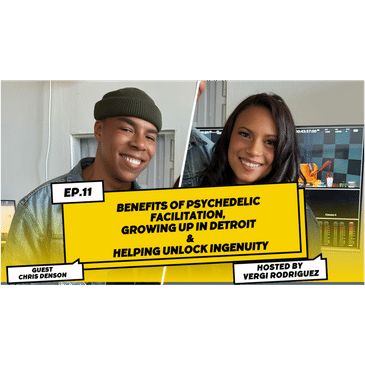
Chris Denson is an Award Winning Innovation Advocate, Thought Leader , Author , Host as well as Detroit Native. He is a creator & Host of Innovation Crush Podcast which has over 750,000 global subscribers.
He has a #1 Best selling book “Crushing the Box : 10 Essential Rules for Breaking Essential Rules." He has applied his expertise to help individuals and organizations increase their innovation potential.
A Race Of Your Own IG : / raceofyourown
Chris Denson https://www.chrisdenson.co/
Don't forget to subscribe. Thanks for listening.
[00:00:00] I almost wore all denim today. Did you? I don't know why I was like the denim look will be for Chris. I appreciate that. I know what that's like. I'm gonna wear this one for this person. Yeah. Or for this thing. You get it. You get it. I have to moderate a panel at a fashion conference tomorrow on AI. Really? And I was like, ooh, I don't know. I was like, I'm wearing this one thing I got that has like technology built into it. Really? Yeah. Like what? Like chips? Uh, like an NFC. Like it's a...
[00:00:30] Kind of like a, or RFID tag. So you can mix it. Oh. Yeah. I haven't even done it yet. My passport, um, my passport... Where are you going? Holder. Where am I going? Away. Um, my passport holder has an RFID thing in it to protect it from people stealing my identity. Or something like that. I don't understand the technology. You're like, obviously... Has your identity ever been stolen? Yes. Oh, okay. On several occasions. Several? Wow.
[00:00:59] So many people want to be me. So... Are we recording it or are we just talking? No, we're just talking shit. Okay. I don't care. No, we're recording it. He might be recording it. If he is, then we'll use it. Yeah, there's always, you know. We'll fucking use it. We'll use it. Fuck it. Use it. Fuck it. Use it. Fuck it. Okay. This is Virgie Rodriguez. Welcome to A Race of Your Own, where we talk about inspiration that leads to resilience.
[00:01:20] And today's guest has a lot of things that I want to cover. He's an award-winning innovation advocate. He's a thought leader. He's an author. He's a host, as well as a Detroit native.
[00:01:32] He's a creator and host of Innovation Crush Podcast, which has over 750,000 global subscribers. A multimedia host.
[00:01:39] He has his number one best-selling book called Crushing the Box, 10 Essential Rules for Breaking Essential Rules.
[00:01:46] And he has applied his expertise to help individuals and organizations increase the innovation potential.
[00:01:51] Welcome to the show, Chris Denton.
[00:01:53] Hey.
[00:01:54] Hey.
[00:01:57] Studio audience.
[00:01:59] I'm so excited.
[00:01:59] Okay.
[00:02:00] I'm so excited to have you here because you were one of the first people I reached out to when I decided to do this series.
[00:02:07] And I was like, hey, Chris, you know, I really like what you're doing and I like the way you do it.
[00:02:11] So I want to do it too.
[00:02:12] And then...
[00:02:14] I remember that conversation.
[00:02:15] Yeah.
[00:02:16] And the advice you gave me was, don't fuck it up.
[00:02:18] And I was like, thanks.
[00:02:21] I'm ready now.
[00:02:24] So thanks for being here and taking out some time because you are one busy individual.
[00:02:29] Sometimes.
[00:02:30] You know, it's ebbs and flows.
[00:02:32] Sorry about that advice I gave you.
[00:02:33] But look at you.
[00:02:34] You didn't fuck it up.
[00:02:35] But look at me now.
[00:02:37] You got to give the person the rule that they need.
[00:02:40] Remember in The Matrix when the Oracle told Neo he wasn't the one and he went away all mad?
[00:02:45] Yeah.
[00:02:45] She's like, why did you tell me?
[00:02:46] He was like, I told him what he needed here.
[00:02:48] Right.
[00:02:49] I get it.
[00:02:50] So I'm Neo in this.
[00:02:52] Yes, exactly.
[00:02:53] Are you the Oracle?
[00:02:56] So they say.
[00:02:57] Yeah.
[00:02:57] Oh my God.
[00:02:59] I'm in my own matrix right now.
[00:03:01] Okay.
[00:03:02] So I don't even...
[00:03:03] I didn't even touch this other thing.
[00:03:08] And visionology, your personal coaching and branding as well.
[00:03:12] Yeah.
[00:03:12] And you just told me something right before we started that you're like, I break myself
[00:03:16] up in three parts.
[00:03:17] I do.
[00:03:17] I do.
[00:03:18] And those parts are...
[00:03:19] So what I like to say is to kind of like help truncate it all.
[00:03:22] I know.
[00:03:23] I like to help people unlock their...
[00:03:26] Sorry.
[00:03:27] I like to help people unlock new levels of ingenuity.
[00:03:30] One is through innovation coaching.
[00:03:32] Two is through content and storytelling.
[00:03:34] And three, I learned psychedelic facilitation and got trained in that and took a trauma recovery
[00:03:41] course.
[00:03:41] So sometimes I'm using one or all three of those skills or tools to help people advance
[00:03:50] forward.
[00:03:51] Nice.
[00:03:51] And then can we...
[00:03:53] Of course, the first one I want to talk about.
[00:03:56] Which is?
[00:03:57] The psychedelic.
[00:03:58] Mm-hmm.
[00:03:59] Hoo-hoo.
[00:04:00] Hoo-hoo.
[00:04:00] Hoo-hoo.
[00:04:00] Hoo-hoo.
[00:04:01] Hoo-hoo.
[00:04:01] No, but the fact that it's tied into the trauma and healing, and I use the word healing
[00:04:08] lightly.
[00:04:09] Yeah, yeah, of course.
[00:04:10] But it's such a...
[00:04:13] You know, a lot of people talk about...
[00:04:15] They're like, ew.
[00:04:15] They just think...
[00:04:16] They hear psychedelic, they're like, ew, shrooms.
[00:04:19] Mm-hmm.
[00:04:19] You know?
[00:04:19] And that's just where their head goes.
[00:04:21] Or like...
[00:04:22] Yeah.
[00:04:23] LSD or something.
[00:04:25] Like, I don't know.
[00:04:25] Why do you say it so sinister?
[00:04:27] Because it's always like...
[00:04:28] That's how people think about it.
[00:04:28] That's how...
[00:04:29] That's how...
[00:04:29] That's the voice of people.
[00:04:31] Dirty hippies.
[00:04:32] Yeah.
[00:04:32] You know what I mean?
[00:04:33] Like, let's do LSD and listen to Grateful Dead.
[00:04:36] You know?
[00:04:36] It's like...
[00:04:37] It's always that.
[00:04:38] Yeah.
[00:04:38] But from your perspective or from kind of the way you explained it...
[00:04:42] No, I think you're absolutely right.
[00:04:43] Like, I was a huge stigma person.
[00:04:46] I was like, uh, that's for a certain demographic.
[00:04:49] Not for me.
[00:04:50] Blah, blah, blah.
[00:04:52] And then I got invited to an experience by somebody I trusted.
[00:04:56] And I was like, okay.
[00:04:59] And it was a psilocybin mushroom experience.
[00:05:02] And immediately came out of that and was like, more people of color need to experience this.
[00:05:08] Experience what I experienced.
[00:05:09] What's psilocybin mushroom versus mushroom at Trader Joe's?
[00:05:15] Yeah, exactly.
[00:05:15] So the functional mushrooms do different things for your cognitive and digestive health.
[00:05:20] And then the psychedelic mushrooms are a little bit more psychedelic, right?
[00:05:24] So they have some things in there that fire off in your brain and your body and kind of...
[00:05:31] They become teachers, right?
[00:05:32] Like, um, and can peel back layers of clarity and awareness and all sorts of things.
[00:05:38] So, um...
[00:05:39] And there's, you know, there's a whole, like, biology to it.
[00:05:42] And every process involves...
[00:05:44] I like to look at it as a three-part process.
[00:05:46] One is intake.
[00:05:47] Let's understand what you might be, A, going through.
[00:05:50] B, if there's any sort of medications you might be on or other things that are going on just to be aware of in the administering of the medicine, right?
[00:05:58] Um, two is the actual experience.
[00:06:01] Sometimes it's a microdosing experience.
[00:06:03] Sometimes it's a deep journey.
[00:06:04] Um, and then three is integration.
[00:06:06] Which, you know, as the industry starts to escalate and crescendo in sort of psychedelics across the country, if not around the world, it's like...
[00:06:17] The integration part is, like, the most important part, right?
[00:06:20] Um, because you may have some great level of clarity and something that's mind-blowing or something that's really symbolic.
[00:06:27] And then you're like, well, where does this play out to me in my job or as a parent or, you know, as just Joe Schmo's citizen?
[00:06:34] Mm-hmm.
[00:06:34] So, um, hoping to sort of take that apart is a big part of the, you know, the experience.
[00:06:42] Mm-hmm.
[00:06:42] So, um, so yeah, it's been, it's been really great.
[00:06:45] I, you know, uh, it is...
[00:06:49] Unfortunately, it's only legal to administer in Colorado and, uh, Oregon.
[00:06:55] Okay.
[00:06:55] Um, and so there's a, you know, there's a whole, like, ecosystems built into those two states.
[00:06:58] You'll start to see, like, a lot more, um, other kinds of clinics and things pop up.
[00:07:03] So in certain states like California, ketamine is legal.
[00:07:06] I don't work with ketamine, but there's other forms of psychedelic therapies that are available.
[00:07:12] So...
[00:07:12] I didn't know that about ketamine.
[00:07:14] Oh, see?
[00:07:14] Okay, see, now I learned something new.
[00:07:16] Yeah, you can, you can walk out the door and go, go get you some.
[00:07:20] Man, I might just have one.
[00:07:21] But, um, but that's amazing.
[00:07:24] And I, and I think that, you know, when you, when you bring in this, like, transformative aspect to it, you know, it, that's amazing.
[00:07:33] You're, you're helping people.
[00:07:34] Yeah.
[00:07:34] And I think, you know, for, like, most of the people that I work with, I always ask if they have a therapist or do they have some other form of spiritual practice?
[00:07:41] Do you go to church?
[00:07:42] Like, what?
[00:07:42] Something.
[00:07:43] Are you reading books?
[00:07:44] Like, are you doing something, like, approaching this from other angles as well?
[00:07:47] Mm-hmm.
[00:07:47] Because this alone, yeah, sure, it can move the needle.
[00:07:50] But I think to have that greater clarity and understanding or advancement, I guess, it's what other tools are you working with?
[00:07:59] Mm-hmm.
[00:07:59] Right?
[00:07:59] And you start to be able to draw parallels or see, I read that and saw this or this is what I was thinking when I was in the experience.
[00:08:07] But then I talked to my therapist about that.
[00:08:09] Like, there's a lot of different ways to, like, continue opening the package.
[00:08:12] Yeah.
[00:08:13] Yeah.
[00:08:13] And it just, it sounds like there's so much stigma around it.
[00:08:17] Like, so much stigma.
[00:08:18] And so, but I also know so many people that are like, oh, my God, you have to try shrooms.
[00:08:22] You have to try this experience and we have to do it together.
[00:08:24] You know, and I'm like, I'm always like, I don't know.
[00:08:27] I look, I, you know.
[00:08:27] I'm so scared.
[00:08:29] Because there is such a stigma.
[00:08:30] There's a stigma.
[00:08:32] There's, you know, there's that one.
[00:08:34] I talk to so many people.
[00:08:36] They're like, oh, I did it years ago and it was terrible.
[00:08:38] Or I had a, you know, somebody, there's an old zoo that kind of looks like all 100.
[00:08:43] And then a friend of mine was like, yeah, I don't know, man.
[00:08:46] The last time we were at the zoo, I was like, why would you do mushrooms at the old abandoned zoo?
[00:08:51] That sounds like a terrible idea.
[00:08:53] Terrible.
[00:08:53] Right?
[00:08:53] Like, so, so a lot of it also is just kind of like resetting the bar with people.
[00:09:00] Like, where are you?
[00:09:00] What do you know?
[00:09:01] What do you understand?
[00:09:03] What don't you understand?
[00:09:03] I don't know all of it, but, you know, I have some pretty good mentors in this space and some
[00:09:07] pretty good resources that I can always go to to try to, like, again, unpack, like,
[00:09:12] what some experiences might be.
[00:09:14] I mean, I've worked with people who are addicts.
[00:09:18] I've worked with people who are just like, hmm, what else is there?
[00:09:20] Right?
[00:09:20] Like, so it's a wide spectrum of human experience.
[00:09:23] And, you know, interestingly enough, it's what led me into my innovation coaching.
[00:09:29] Because there was a friend of mine who I worked with, who I really admire.
[00:09:34] And we had just been having some personal conversations.
[00:09:36] This person has been sober all of their life, another drop of alcohol, nothing.
[00:09:41] And was like, hey, I realize I need to work on some stuff.
[00:09:44] And it was kind of focused and centered on his career.
[00:09:48] And he's like, but I don't know if that's for me.
[00:09:50] And I was like, you know what?
[00:09:51] I've been playing around with this idea for a while.
[00:09:52] Well, let me get back to you in a few weeks.
[00:09:56] And that's where I, like, I created Visionology.
[00:09:58] So it's this 11 session innovation coaching program.
[00:10:03] But it's a lot of the same mechanics as you would work with somebody through a therapeutic process.
[00:10:07] It's like there's an 80%, at least in the beginning, what I like to call, like, the invisible blocks.
[00:10:13] It's like, oh, you know.
[00:10:14] And then there's 20%.
[00:10:15] What's your tactics, strategies, creative process, et cetera, et cetera.
[00:10:19] And then over the course of time, that ratio begins to shift where it's like, all right, 20% of it is just like the invisible emotional intelligent check-ins.
[00:10:28] And the 80% becomes like, you know, what's the strategy behind this product, service, you know, idea, et cetera, et cetera.
[00:10:35] And that can be a small team at a corporation or an individual entrepreneur on their own journey.
[00:10:40] But the whole idea is like, how can I see myself differently and in the quest, in the pursuit of this thing that I'm creating?
[00:10:48] Right.
[00:10:49] And you change your relationship with it, you start to see different results, you know.
[00:10:53] So it's, but it's cool.
[00:10:54] Like, I always found that even when I was like working in the innovation economy, just like for agencies or advising startups,
[00:11:02] most of the reasons good ideas didn't happen weren't because of the idea itself.
[00:11:07] It was usually because of some human that was like scared about losing their job.
[00:11:11] I've been worried, you know, or they like, they tried something two times ago and failed or got burned by a partner or, you know,
[00:11:19] or they've been at the same thing for three years and they haven't had a breakthrough.
[00:11:22] And it's like, let's unpack some of the emotional hurdles that come along with career journeys because there's not a lot of places to talk about that.
[00:11:30] And to, to what you're saying, see for me and I was, and probably me, like, exactly.
[00:11:37] Exactly.
[00:11:38] Um, uh, this is going to be so unhinged and I love it.
[00:11:43] Um, you know, there's, there's people that, you know, this is it.
[00:11:49] When we're talking about innovation, when we're talking about ideas, right.
[00:11:53] We live in a world where social media.
[00:11:56] In a world.
[00:11:57] In a world.
[00:11:59] Where it's dark.
[00:12:01] Um, we live in a world that is just so much social media.
[00:12:05] We are constantly being fed something, which has always been like that even growing up, right?
[00:12:11] Television, movies, whatever.
[00:12:12] But like social media is just like triple, like quadruple that.
[00:12:16] Right.
[00:12:17] And we've talked about this before too, outside of here where it's like, I came up with this idea.
[00:12:22] And then like, you know, I'm seeing friends.
[00:12:25] This is a perfect example.
[00:12:26] Like even, even talking about like city of Detroit.
[00:12:29] I had like this idea with a friend of mine had a, uh, a film concept.
[00:12:34] He had the rights to tell somebody's story out of Detroit.
[00:12:36] And I was like, Ooh, I came up with this marketing idea for like, um, the city of Detroit.
[00:12:41] And like, it would be great to like, you know, make the backdrop and like pump the city.
[00:12:45] And like so much that's going on with the city now.
[00:12:48] And like, you know, they're really pumping in.
[00:12:49] And I'm like, wait, but that's an idea I had.
[00:12:51] And it's like the universe kind of being like, well, did the universe hear me?
[00:12:56] Like, are you listening to me?
[00:12:57] So now you see the outside world showing you an idea, you know, it's so innovative, you know?
[00:13:03] I mean, there's so many, right?
[00:13:05] Ideas.
[00:13:05] But it's like, it's so innovative, which then makes me as a creative go, that was my idea universe.
[00:13:12] Why are you listening?
[00:13:14] You know what I mean?
[00:13:15] Like.
[00:13:15] I think if you've read Rick Rubin's book.
[00:13:18] No.
[00:13:18] It's so good.
[00:13:19] It's such a great book.
[00:13:20] And or you can like, oddly, I rarely listen to or watch podcasts.
[00:13:26] Except for this one.
[00:13:29] How do you think that?
[00:13:31] But like, there's a great interview with Rick Rubin and Jay Shetty.
[00:13:35] And then in Rick's book, he talks about that very thing.
[00:13:39] He's like, sometimes you have a great idea and all of a sudden you see it in the world.
[00:13:43] Yeah.
[00:13:44] And you're like, and the way he says it is that it's not necessarily that someone stole your idea.
[00:13:48] It's more that it was that idea is time to be born.
[00:13:52] And so you went and started talking about the universe and the sort of mysticism of it all.
[00:13:59] That's a, you know, for some, it's a very real thing.
[00:14:01] It's a very real part of the creative process.
[00:14:04] And, you know, and that ability to like, I always look at that as like, okay, I'm always on the right track.
[00:14:10] Right.
[00:14:10] If I, maybe it's not that idea that I get to do.
[00:14:12] The reframing of that.
[00:14:13] Because again, my whiteboard is filled with like things I'll probably never, ever get to.
[00:14:18] And sometimes I'm like, ah, that's the one I should have worked on.
[00:14:21] Right.
[00:14:22] Right.
[00:14:22] Right.
[00:14:22] Right.
[00:14:23] Oh, man.
[00:14:23] Instead of this wild cookie thing that I'm like, ooh.
[00:14:26] So do you believe in just like spitting out, like whether that's on a mood board or like whatever,
[00:14:30] just like sitting down and just spitting out a ton of ideas versus like picking one and focusing on one?
[00:14:35] You know what I mean?
[00:14:36] Because in that particular situation, that's kind of what happened.
[00:14:38] I was like focusing on one and like hoping for one and wishing for one.
[00:14:42] And then it was just like, the universe shows me that.
[00:14:45] Right.
[00:14:46] Right.
[00:14:46] Yeah.
[00:14:46] So, so at that point it's like, well, okay, cool.
[00:14:50] I'm on the right track.
[00:14:50] Well, at least I have three others.
[00:14:52] But then some people would say, no, pick one and focus on one.
[00:14:55] It depends.
[00:14:56] It depends on the individual.
[00:14:57] Right.
[00:14:57] Like some people are multi-hyphenates.
[00:15:00] I have friends who are like fashion designers, actors, producers, run a nonprofit, run a marketing
[00:15:06] company.
[00:15:07] I'm thinking of one person in particular.
[00:15:07] And they do all these things.
[00:15:09] They have one primary like vocation.
[00:15:12] Yeah, exactly.
[00:15:12] That is their, their main thing.
[00:15:14] But they do all those things to a really high level.
[00:15:16] Yeah.
[00:15:16] And, you know, but that person's brain can function that way.
[00:15:21] Right.
[00:15:21] Right.
[00:15:21] And I think you have to really.
[00:15:23] Without psychedelics.
[00:15:23] Yeah.
[00:15:24] And you have to.
[00:15:25] Exactly.
[00:15:26] You know, I'm on psychedelics.
[00:15:27] It'd be really crazy.
[00:15:28] Right.
[00:15:28] No, I think.
[00:15:29] So you have to understand who you are.
[00:15:31] And so like, even in my book, my first chapter, I talk about empathy and empathy isn't just
[00:15:35] understanding the people that you're working with and the people that you're creating for.
[00:15:39] It's also understanding yourself and like how, you know, what moves you, what motivates
[00:15:44] you, what makes you feel at ease and at peace.
[00:15:46] And I know even in my own world, yes, I have like a lot of different buckets of things
[00:15:50] that I'm interested in and things that I do.
[00:15:52] But I also, because of my brain, I have to carve out very specific time to focus on each
[00:15:58] of those things.
[00:15:59] Otherwise, like I will go haywire in a day if I'm talking about project A here, project
[00:16:05] C there, having a serious conversation.
[00:16:07] And then one meeting moves and I've got to keep switching brain modes.
[00:16:12] So, you know, it's organizing around how you can have your best output.
[00:16:16] And then on top of that, yes, it's like, I don't know, out of the 20 ideas on my white
[00:16:21] board, I have to go, which one do I feel most passionate about?
[00:16:25] You know, because we can easily ask the business question like, all right, what's happening
[00:16:28] on social media right now?
[00:16:31] What's trending on whatever platform?
[00:16:33] What's happening in the startup ecosystem?
[00:16:35] Whatever your mechanism is, it's like there's that pull, which is the facts and where the
[00:16:41] data is pointing.
[00:16:43] And then there's the fun of just kind of following your intuition, which is a really
[00:16:47] learned habit.
[00:16:49] You know, some of us can tap into it a lot easier than others.
[00:16:55] And some like me, I'm like, I have shiny object syndrome.
[00:16:58] Like, I'm always like, oh, that looks, ah, wait, let's put this down and like go right
[00:17:02] over there.
[00:17:03] Like, wait, what about us?
[00:17:04] So I have to really manage my personality and my execution style.
[00:17:09] So interesting.
[00:17:10] Okay.
[00:17:11] And that's, and that, and yes.
[00:17:14] Yes.
[00:17:15] Because I feel like for me, I don't, I, it fluctuates.
[00:17:20] It goes from being focused on one and being so passionate about it.
[00:17:24] Because they, I treat them as like these little babies.
[00:17:26] Like, I'm just like, oh, it's like this little thing.
[00:17:29] It's so cute.
[00:17:30] And then.
[00:17:30] Some of them babies got to die.
[00:17:31] Oh man.
[00:17:32] Kill the babies.
[00:17:33] No.
[00:17:35] No.
[00:17:37] No, it's, there's a, there's a platform I like to use called My Human Design.
[00:17:44] And it's just like, it's kind of like a personality profile.
[00:17:47] Go ahead.
[00:17:48] It's called Human Design.
[00:17:49] Yes.
[00:17:50] It's a, that's a, human design is a practice.
[00:17:52] But it's like if you did a disc assessment or astral, like whatever.
[00:17:55] Like a chart for astrology.
[00:17:56] However you go to understand yourself.
[00:17:57] I've heard about this and I don't get it.
[00:18:00] It's very confusing.
[00:18:01] Wow.
[00:18:01] It's very easy.
[00:18:02] Download that.
[00:18:02] Did you download that?
[00:18:03] I have no affiliation with it, by the way.
[00:18:05] I think I'm a generator.
[00:18:06] Yes.
[00:18:06] Me too.
[00:18:07] So here's the thing about generators.
[00:18:09] Right.
[00:18:09] And this is what was true for me is like, you have to learn the difference between what
[00:18:15] you're passionate about and what you're flattered by.
[00:18:18] This is just one component.
[00:18:19] Right.
[00:18:19] Because sometimes you'll do a job on a project or work with somebody or build something
[00:18:24] and people go, I like that.
[00:18:26] Great job, Virgie.
[00:18:28] Right.
[00:18:28] Can you come do that for us?
[00:18:30] And you're like, yeah, I'll do it.
[00:18:31] And, you know, as maybe for those types of people as kids, as like most of us, your parents
[00:18:37] told you good job when you did something well and they probably told you you were on
[00:18:42] punishment when you messed up.
[00:18:43] Yeah.
[00:18:44] So we start to seek that emotional connection to like, good job.
[00:18:47] Good job.
[00:18:48] So now I'm doing these things that I'm good at.
[00:18:50] Right.
[00:18:51] But I'm not passionate about.
[00:18:52] Right.
[00:18:53] And so I have to like sometimes shut out the voice of the world and go like, this doesn't
[00:18:58] make sense.
[00:18:58] Or why would you do that?
[00:19:00] Or come do this with us.
[00:19:01] Or, hey, remember last time you did like last time isn't right now.
[00:19:05] Right.
[00:19:06] Right.
[00:19:06] So I have to really tap into like, am I emotionally connected to whatever it is I'm about to step
[00:19:11] into genuinely.
[00:19:12] So even when I look at my whiteboard, there are some things that are hard to eliminate,
[00:19:17] but I like I know which ones actually even in my book, I talk about like the goosebump
[00:19:22] ideas.
[00:19:23] Right.
[00:19:23] There's you might have 20 ideas, but a couple of them are going to be the ones that give
[00:19:27] you the goose bumps.
[00:19:27] You're like, oh, all right.
[00:19:29] That's the one I did.
[00:19:30] And sometimes there's somatic indicators.
[00:19:32] Sometimes it's an intellectual indicator.
[00:19:33] Yeah.
[00:19:34] Or sometimes you're like, oh, somebody already did that.
[00:19:36] All right.
[00:19:37] Yeah.
[00:19:37] Yeah.
[00:19:38] I, for some reason, I just, I still, I struggle with, you know, and I wonder if like
[00:19:42] viewers struggle with that too.
[00:19:44] It's like you get so stuck on it that like, like it'd be, it's literally like a death.
[00:19:49] Yes.
[00:19:49] It's like, it's like I have to watch it die.
[00:20:20] Right.
[00:20:21] And away.
[00:20:22] Right.
[00:20:22] Because you've left something familiar behind.
[00:20:24] You don't know these new people that you're working with.
[00:20:27] You don't know all the processes that go along with this new responsibility, et cetera, et
[00:20:32] cetera, fill in the blank.
[00:20:33] And I think we, you know, in many cases we owe it to ourselves to kind of just like mourn
[00:20:38] a loss, even if you're headed in a positive direction.
[00:20:42] Yeah.
[00:20:43] And so it's that sort of like, so whether that idea didn't happen, like even if it's
[00:20:48] just for two minutes and you go like, oh, I do feel shitty about having lost that thing.
[00:20:51] Because most of us have been trained to go like, well, onto the next one.
[00:20:55] Right.
[00:20:55] Which, you know, which is also a valid skill.
[00:20:58] But if you couple it with just acknowledging that it kind of hurt or, you know, or that
[00:21:04] even the idea that it might've hurt.
[00:21:06] And that's where I find the resilience.
[00:21:07] That's why, you know, part of like the series is like still being resilient.
[00:21:11] It's like I've learned alchemy.
[00:21:13] You know, alchemizing stuff and kind of channeling that or funneling that in another direction,
[00:21:22] which it still might be that in another way.
[00:21:27] Yeah.
[00:21:27] You know, and it's interesting and it's fascinating to watch because I've, once I've kind of
[00:21:33] accepted and I want to dig into your essential rules for breaking essential rules because I'm
[00:21:38] a rule breaker and I love breaking rules.
[00:21:42] And so, but, you know, I've, I've learned to kind of just accept and just be still.
[00:21:49] And I talked about this with another guest, which was just like being still, like being
[00:21:53] in the present, but really just shutting up, just shutting up, just shutting, shutting
[00:21:58] it all.
[00:21:59] I just so there's so many distractions.
[00:22:00] There's so much outside shit going on constantly.
[00:22:04] I mean, even just like, like you're sitting at home.
[00:22:07] A lot of us work from home.
[00:22:08] So we're sitting at home.
[00:22:10] Viewers, I'm sure, sit at home, work from home.
[00:22:11] You're on a computer.
[00:22:13] Construction across you.
[00:22:14] You're about to get on a phone call and there's the one day.
[00:22:16] It's my dog barking at the garbage truck.
[00:22:18] That's the one that always gets me.
[00:22:20] Always.
[00:22:20] And you're like, I just wanted some peace.
[00:22:23] So I'm just learning to, even if the dog barks or even as a construction truck or whatever,
[00:22:29] to just don't let it distract.
[00:22:31] Right.
[00:22:32] That has been such a big kind of lesson in all of it and in creating, which is to me
[00:22:42] innovation.
[00:22:43] And maybe that's not the correct definition of that.
[00:22:47] But they cross.
[00:22:48] I'm sure.
[00:22:50] But at least in my world, they do.
[00:22:52] I don't know.
[00:22:55] But, you know, really just like kind of shutting it all out, including my brain.
[00:23:02] Right.
[00:23:02] Because it's not necessarily sometimes always just like, all right, let me just get on
[00:23:06] my, like I was telling another guest.
[00:23:07] It's like, oh, I can order food from my phone.
[00:23:10] I can order.
[00:23:11] It's easy to be distracted.
[00:23:12] I can order food from freaking sheets, you know, on Amazon.
[00:23:15] I can, I can watch a whole TV series.
[00:23:17] I can do so much on my phone.
[00:23:19] It's so distracting.
[00:23:20] Yeah.
[00:23:21] But it's even once you shut that down, shutting your brain off to be like, stop the limiting
[00:23:26] thoughts, the limiting beliefs.
[00:23:27] I gotta do this.
[00:23:28] I gotta do this.
[00:23:28] I will tell you like.
[00:23:31] Do psychedelics help with that?
[00:23:33] Yeah, they can.
[00:23:34] I mean, you know, it's like think about what you're thinking about.
[00:23:36] Right.
[00:23:37] Kind of thing.
[00:23:37] And like, I feel like when you first start to enter a transformational period of your
[00:23:43] life, the task of monitoring your thoughts is the most mindfuck of a task you can do because
[00:23:51] like literally every thought you catch, you're like, oh, I'm doing it again.
[00:23:55] Oh, there's another one.
[00:23:56] And you also have to like go to work, show up, do all the things you like.
[00:23:59] All the things.
[00:24:00] But then, and, and eventually, hopefully it almost feels like you kind of run around catching
[00:24:05] butterflies, right?
[00:24:06] Like, oh, there's one like, which is a little bit more of a joyous task than like reaching
[00:24:11] into a, you know, a pool full of piranhas and trying to grab one and throw it out.
[00:24:16] Right.
[00:24:16] Like until the pool's empty.
[00:24:18] Right.
[00:24:18] And stillness is, it's a practice, right?
[00:24:23] I think most of us like, oh, I've been meditating for two months and whatever.
[00:24:27] I'm a guru.
[00:24:28] I mean, my last sort of, I don't know, like rocky period was probably about two and a half,
[00:24:35] three years.
[00:24:36] And during that time, I was like, I had, I heard this quote recently that I was like,
[00:24:41] that's what it is.
[00:24:43] Which is discipline is the highest form of self-love.
[00:24:47] And I've heard that too.
[00:24:48] And I like, you know, I lost like a lot of, you know, job opportunities and, you know,
[00:24:53] a lot of big changes in my life and some losses and so on and so forth.
[00:24:57] And I was just like, kind of the only thing I have right now is for me to get up every morning
[00:25:04] at 530, do my journaling, do my meditation and stick to it.
[00:25:08] And there were days I was like journaling, making a gratitude list with tears in my eyes.
[00:25:14] It's like, and there's only three things on the list.
[00:25:17] Letting that emotion out.
[00:25:18] Right.
[00:25:18] And so it's just this like, but through that, the stillness period gets longer and longer
[00:25:26] and longer.
[00:25:27] Your ability to sustain it.
[00:25:28] Because yes, the dog's going to bark at the garbage truck, right?
[00:25:31] Yeah.
[00:25:33] Metaphorically speaking.
[00:25:35] And, you know, or the other, the shiny object is going to show up and be like, well, this
[00:25:39] is what I was working on before.
[00:25:41] And now I can, it shows like you chase it and then it falls apart.
[00:25:44] You're like, well, what happened?
[00:25:45] Right.
[00:25:45] You know, because that stillness is like, oh, was that, was that flattery or was that,
[00:25:50] you know, passion?
[00:25:51] Right.
[00:25:51] And that's just one mechanism.
[00:25:53] I'm not saying it's always just flattery or passion, but again, everybody's different.
[00:25:56] And so kind of understanding nuances, triggers, desires, history, it takes a little bit of
[00:26:02] time.
[00:26:03] But yeah.
[00:26:03] And that thing, you know, sorry.
[00:26:05] No, I'm, I'm like, yes, yes, yes.
[00:26:08] Go more.
[00:26:10] And that's why, and, and, you know, in hindsight, when I, when I wrote the book came out in
[00:26:14] 2018 and I didn't realize, I didn't realize at the time that I was writing like a book
[00:26:20] that was like 50% personal development and 50% like business tactics.
[00:26:24] I, it was, you know, I started with empathy cause I was like, I worked for a marketing
[00:26:29] agency at the time and I had clients and then I had their customers that I always had to
[00:26:34] think about.
[00:26:34] And I also had to think about my team and the other teams that I'm working with.
[00:26:38] So it was always like a social navigation versus like, Ooh, a creative process.
[00:26:42] So, um, so yeah, that was, it was just one of my entry points.
[00:26:46] Um, which is amazing because it's like, it's no, and I keep, I always use the word amazing
[00:26:54] and I'm always like, because I can't think of another word.
[00:26:55] It just, I really, I really believe it.
[00:26:57] It is amazing.
[00:26:58] Like the work that you're doing is like, you can't do this work unless you're really fully
[00:27:05] a hundred percent authentic.
[00:27:08] Like you, nobody's going to buy.
[00:27:09] Oh yeah, I'm stupid.
[00:27:10] Like I know, no, nobody's going to buy what you're selling and not that you're even
[00:27:14] selling it.
[00:27:14] You're not really selling it in that sense.
[00:27:17] Right.
[00:27:18] You were really going out into the world and wanting people to be innovative and encouraging
[00:27:25] their innovation.
[00:27:26] We need it.
[00:27:27] Like it's not like, as much as I want it, it's also like you look at anybody who's trying
[00:27:33] to solve a problem, whether it's small, like, Oh, how can my phone run faster?
[00:27:37] Or it's like climate change is a thing and we need to fix it.
[00:27:41] And so I think also from a tactical standpoint, I've worked in AI and virtual reality.
[00:27:50] Like, so we start thinking of innovation from a technology standpoint.
[00:27:53] I can also speak that language.
[00:27:54] I cannot make anything to save my life.
[00:27:56] I can't code.
[00:27:57] I just learned how to make my first AI character.
[00:28:01] I learned how to make my first.
[00:28:02] What'd you make?
[00:28:03] It's literally me, but AI.
[00:28:06] It's freaking weird because it looks nothing like me.
[00:28:09] Not yet.
[00:28:10] But you don't want to look too much like you.
[00:28:11] I don't want her to look like me at all.
[00:28:13] Because it'll be talking to people on like your Tinder profiles and it'll be like, I didn't
[00:28:17] say that.
[00:28:18] Oh, I don't do Tinder.
[00:28:19] Vergie too said that.
[00:28:20] I don't, I don't need to do Tinder.
[00:28:22] I'm just, it's only an example.
[00:28:24] I just thought I would throw that out there.
[00:28:25] I'm just kidding.
[00:28:26] But, but no, but, but, you know, because it's, again, I talk about so many different
[00:28:32] things on here, but, you know, I'm fascinated by like people and like what got them there.
[00:28:38] Right.
[00:28:38] So it's like, what got you here?
[00:28:39] What, what was, what was, was this Chris, you as a kid growing up in Detroit?
[00:28:44] Like what, what, like what, what got you here?
[00:28:47] Like what made you be like this person who is like so far ahead thinking?
[00:28:54] You know what I mean?
[00:28:54] Like what made you think?
[00:29:19] I mean, we, there's, there's, there's a world of thought leaders and innovation leaders and
[00:29:24] I have two older siblings.
[00:29:27] RIP, one of them died earlier this year.
[00:29:30] But they, by the time I came along, they're 12 and 13 years older than me.
[00:29:35] By the time I came along and was four or five years old, I was kind of like an only child,
[00:29:40] right?
[00:29:40] Cause they had moved on, like gone out of the house.
[00:29:43] Um, and it was just me and my mom and my mom had gone through a divorce the year I was born.
[00:29:49] And so she at 33 had just like started going back to college and that was basically living her twenties out as a single mother of three children and was like taking belly dancing lessons and roller skating and like, and then she taught fashion design.
[00:30:06] And, and, and, you know, because I was, I just went with her to a lot of places.
[00:30:10] Classes.
[00:30:10] Yeah.
[00:30:11] And so I think later on, like, I just would try things.
[00:30:15] I tried to stand up comedy.
[00:30:16] I've been a comedy writer.
[00:30:18] I've, you know, I've worked as an engineer at Chrysler after I graduated school.
[00:30:22] I was an RA.
[00:30:23] I was a student council.
[00:30:24] I was just like, hmm.
[00:30:25] Involved.
[00:30:26] Yeah.
[00:30:26] I'd never really said no too much, almost to a fault, like to a fault many times.
[00:30:31] Um, and I think as the years have gone by, I'm like, okay.
[00:30:35] Like, let me put these pieces together of my lived experiences and interests and just kind of like, well, how can I make this make sense to everybody else?
[00:30:47] Interesting.
[00:30:47] And myself.
[00:30:48] And you're like, and me too.
[00:30:50] Yeah.
[00:30:50] Cause I'm like, how do I, and that's usually like, especially if I'm working with somebody who's a multi-hyphenate.
[00:30:54] It's like, how do I say this to people?
[00:30:58] How do you rein it in?
[00:30:59] And make it like, make it present as valuable to whomever I'm talking to.
[00:31:04] Cause we're all selling something at some point.
[00:31:07] Right.
[00:31:07] Right.
[00:31:07] So whether you're doing it on LinkedIn or you're doing it at a, you know, at a barbecue.
[00:31:11] Trying to sell this show.
[00:31:12] Right.
[00:31:12] Like, so how you present, how you explain, how you understand what it is that you do.
[00:31:19] And again, empathy come also comes into like, I know not everybody's going to get what I'm talking about or be on the same level.
[00:31:25] And that can be somebody who's created a technology tool, written the script.
[00:31:28] And it's just like, how, what's the easy, what's my easiest way to explain this to a person?
[00:31:33] I had a friend of mine who started a business and for about 30 minutes, I asked him, well, oh, what does it do?
[00:31:40] So for about 30 minutes, I was like.
[00:31:43] Still, you still didn't know what it did.
[00:31:45] And I was like, hey, this is back when Twitter still had 140 characters.
[00:31:47] I was like, go as a, when you get back to, we were at a conference.
[00:31:52] You mean X?
[00:31:52] When you get back to your hotel, it was Twitter at the time.
[00:31:55] Still.
[00:31:56] But I was like, when you get back to your room, try to tell me everything you told me in 140 characters or less.
[00:32:03] Right.
[00:32:04] So how do you get all that information?
[00:32:06] We do this, we do that.
[00:32:08] In a tweet.
[00:32:08] We care about this, this, and like, how do you get it down to like one sentence that you understand and other people will understand.
[00:32:15] Right.
[00:32:15] So, because it's hard, it's hard to like, I love all these things.
[00:32:20] And then.
[00:32:22] But you can't do them all.
[00:32:22] I remember I was just having that thought the other day about like when I was a kid, I remember going to my mom and just, you know, being like, you know, I want to be an astronaut and I want to be a doctor and I want to be a dancer and I want to be.
[00:32:36] And she's like, you have to go on.
[00:32:38] And I was like, why?
[00:32:39] Yeah.
[00:32:40] But why?
[00:32:40] Which isn't necessarily true.
[00:32:41] There was a great TED talk and your listeners and viewers can go look it up.
[00:32:44] Yes.
[00:32:45] Um, this woman gave us probably like a five or 10 minute talk about being a multi potentialite.
[00:32:51] And it's just like, what has happened if I do want to be an astronaut and an author and blah, blah, like fill in all the blanks.
[00:32:59] And, you know, and how do you, how do you foster that in a human being?
[00:33:03] I think it's generational.
[00:33:04] Like, I don't know.
[00:33:06] The downside to my mom's experience that I just explained was also like, this is how you do everything.
[00:33:12] Like, this is the method and you do this, you do that.
[00:33:15] And then you do that.
[00:33:15] And I'm like, there's millions of possibilities of executions and existences.
[00:33:21] But I had to like, undo that because it was subconscious that I was like, I was conditioned to believe like, you go and you do and you like, so there's not a lot of common language around how do you manage doing multiple things.
[00:33:37] And granted, there's value to like, doing one thing and being focused and honed in, um, you know, and it's just like that balance.
[00:33:46] Uh, I had this, this is going to be a sound a little strange.
[00:33:48] I was in Bend, Oregon last week and I had this experience where I was doing, uh, a friend of mine was leading a meditation like outside.
[00:33:57] And basically I was looking at a rabbit and I saw a rabbit and, um, and then he said something about a falcon and I was like, okay.
[00:34:04] Uh, but a couple hours later we were just hanging out and he was like, yeah, a falcon landed behind you.
[00:34:10] And I was like, what?
[00:34:11] Like, he's like, you know, maybe like 10 feet.
[00:34:13] And you didn't know it was there?
[00:34:14] I didn't know.
[00:34:15] Cause he was standing behind, he was standing behind me and he started talking about how falcons in some cultures represent focus.
[00:34:23] Right.
[00:34:23] And that's how they hunt where some birds of prey will like, they'll hover and look like falcons are like, nope, that's a, and rabbits, what they scurry.
[00:34:33] So this, this difference between focus and like flittering about, right.
[00:34:39] And both existences are real and they exist, but that rabbit was about to get tore up.
[00:34:44] Tore up by that falcon.
[00:34:47] Yeah.
[00:34:47] Wow.
[00:34:48] Yeah.
[00:34:48] That's a great kind of like scenario there.
[00:34:51] Like just even thinking of like seeing that, like, do you want to be the scattery bunny or do you want to be the focus falcon?
[00:34:57] Yes.
[00:34:57] And that's what I'm going to title this episode.
[00:34:59] Be a focus falcon.
[00:35:01] Ooh, nice.
[00:35:02] I was going to say the falcon and the rabbit, but that's a, but that sounds like a fable.
[00:35:06] I'm about to go.
[00:35:07] See, now I've got another idea for the white boy.
[00:35:09] Yeah.
[00:35:09] Falcon and the rabbit.
[00:35:11] Falcon and the rabbit.
[00:35:11] Forget the tortoise and the hare.
[00:35:12] Forget the tortoise and the hare.
[00:35:14] That's done.
[00:35:14] That's so 1841.
[00:35:15] Yeah.
[00:35:16] That's done.
[00:35:17] This is 2024, 25 almost.
[00:35:20] Almost a hundred years later.
[00:35:21] Yes.
[00:35:21] We got a new, we got a new one.
[00:35:23] We got a new fable.
[00:35:24] We have a new fable.
[00:35:26] It's the focus falcon and the scurried rabbit.
[00:35:28] Yes.
[00:35:29] Scurred.
[00:35:30] The scurred rabbit.
[00:35:31] Don't be scurred.
[00:35:32] Don't be scurred at all.
[00:35:33] So if, if there's like, there's a quote that I found on you and I got, I got to start wrapping
[00:35:38] this up a little bit here, but, but, um.
[00:35:40] Oh, there's a clock there.
[00:35:42] There is.
[00:35:44] There is.
[00:35:45] I feel like it's partially my fault.
[00:35:46] No, not at all.
[00:35:47] I'm, I'm, I just like having these conversations.
[00:35:50] Go on, ask him.
[00:35:50] Just like, you know, dipping into this stuff.
[00:35:53] Now he's telling me how to run my own podcast.
[00:35:54] We only have.
[00:35:57] Jesus.
[00:35:59] Yes.
[00:35:59] So Forbes quoted you as saying, well, Forbes.com, the more limited you are, the more creative
[00:36:07] you have to be.
[00:36:09] Time constraints eliminate second guesses.
[00:36:11] Constraint is a unifier.
[00:36:13] Yes.
[00:36:14] So some of the best.
[00:36:15] Divulge.
[00:36:16] Some of the best.
[00:36:17] I'm being mindful of time.
[00:36:18] Some of the best innovations come from constraint, right?
[00:36:20] You don't have enough time, money, people, resources, and you're like, but I need to get this
[00:36:25] done.
[00:36:26] Right.
[00:36:26] So innovation isn't always like the outcome.
[00:36:28] Um, for me, it's like an operating system.
[00:36:30] It's like how, you know, what are all the moving bits and pieces that go into the machine
[00:36:34] that creates the thing?
[00:36:36] So, um, and a lot of times if you give, I think it was, um, there's a director who like
[00:36:42] made some really classic low budget movies, like Clerks.
[00:36:45] Uh, Kevin.
[00:36:46] Yeah.
[00:36:46] I'm drawing a blank.
[00:36:47] I was going to say that Kevin.
[00:36:49] But he was like, you give me.
[00:36:50] I was going to say Kevin Costner.
[00:36:52] No, it is Kevin though.
[00:36:53] And beard.
[00:36:54] You guys were in hockey jersey.
[00:36:55] I feel like.
[00:36:56] Anyway.
[00:36:56] Yeah.
[00:36:57] Yeah.
[00:36:57] He, Clerks was like some really low budget movie.
[00:37:00] And then he's like, you give me $20 million.
[00:37:02] I'll make a shitty $20 million movie because it's too much for us.
[00:37:06] Too many options.
[00:37:07] Right.
[00:37:07] Right.
[00:37:08] When it's go time and this is all you got.
[00:37:10] And it's like people figure it out.
[00:37:11] Every startup that's they, whether you bootstrap or whatever.
[00:37:15] I mean, you think about Uber, like they didn't have an investor at the beginning.
[00:37:18] Right.
[00:37:18] So it was like, okay, how do we build this technology tool and let people be aware of it?
[00:37:23] And then it grows into this big behemoth.
[00:37:25] But like the types of restraint that goes into like the early stages of any idea.
[00:37:30] Yeah.
[00:37:31] Is actually a value.
[00:37:34] Yeah.
[00:37:35] That's fascinating because you're right.
[00:37:37] Yeah.
[00:37:37] Because you can make.
[00:37:38] I mean, look at hip hop.
[00:37:40] Right.
[00:37:40] It's like we don't have instruments.
[00:37:42] No.
[00:37:42] We have a turn table and some old records.
[00:37:44] Samples.
[00:37:44] And a microphone.
[00:37:45] Sampling.
[00:37:45] Right.
[00:37:46] Sampling.
[00:37:46] That's just what it was.
[00:37:48] Yeah.
[00:37:48] And I find that fascinating.
[00:37:50] One of the things I like to touch upon here, which is one of the things you told me, a second
[00:37:54] piece of advice you gave me after you said, don't fuck it up.
[00:37:57] The second piece of advice you gave me was, you know, just kind of just like.
[00:38:01] That was a joke advice, by the way.
[00:38:03] Oh, was it?
[00:38:04] For everybody.
[00:38:05] They think that's how I work with people.
[00:38:07] This whole time.
[00:38:08] Don't fuck this up.
[00:38:08] I do have a lot of levity when I work.
[00:38:10] Anyway, go ahead.
[00:38:10] This whole time I thought you were being honest.
[00:38:13] Anyway.
[00:38:13] Anyway, but was, you know, sticking to like some theme.
[00:38:18] Right.
[00:38:18] And like what what would I want my audience or my viewers to take away?
[00:38:22] Which is, you know, what would you say?
[00:38:24] What piece of advice would you give people to be to stay in a race of their own?
[00:38:28] You know, you're going to go through valleys and up and down and plateau and, you know,
[00:38:34] tumbleweeds throughout life.
[00:38:36] But what what are those things that you would say if there was one thing you would tell someone,
[00:38:40] you know, because innovation, it sounds to me like what I'm grabbing.
[00:38:43] For me, what I'm what I'm hearing is that innovation isn't just first of all, it's not linear by any means.
[00:38:49] Being creative is not linear by any means.
[00:38:52] You know, there's going to be peaks and valleys.
[00:38:54] Right.
[00:38:55] And sometimes really high peaks and really low valleys.
[00:38:58] Yeah.
[00:38:59] And so what what is like there's the one thing you would tell somebody if they're looking or thinking of an idea,
[00:39:05] if a viewer is thinking of an idea or something that they want to explore,
[00:39:08] what would be the thing that to help them stay on track?
[00:39:11] Right.
[00:39:11] And stay on course.
[00:39:14] I don't know if this is my best answer, but it's the one that I have in my head right now,
[00:39:18] which is remain unattached.
[00:39:21] Like and practice remaining unattached because unattached doesn't mean you don't care.
[00:39:27] You don't have a passion for it.
[00:39:30] It's just your emotional roller coaster that you go on.
[00:39:34] If you're in any kind of creative pursuit of like, oh, yeah, we got a third meeting with this funder or that company or a collaborator.
[00:39:42] And then it doesn't go anywhere.
[00:39:44] It's like the the expansion and contraction of your emotional experience is ridiculous.
[00:39:50] Like so when you talk about stillness earlier, it was like, can you be still even in that conversation?
[00:39:56] Like I used to go from I went from like, oh, I was counting the number of people that didn't email me back.
[00:40:03] Right.
[00:40:04] I'd be like I had a spreadsheet and all my correspondences and so on and so forth.
[00:40:09] And I realized like I was holding each one of those missed opportunities like here.
[00:40:15] Right.
[00:40:16] So and then when the great things come, you expect it to continue.
[00:40:22] Right.
[00:40:22] Like you expect the domino.
[00:40:23] But if anything that's universal is that life ebbs and flows.
[00:40:28] And even if somebody like you think is doing great on the outside and they're public facing like you.
[00:40:33] I just watched some clip of a podcast yesterday with Tony Rock.
[00:40:36] And he was talking about how Chris Rock has never put him in a movie.
[00:40:41] But that was the first time he had spoken about it.
[00:40:43] And so if you see him do a stand up and like, you know, like he's one of he's funny.
[00:40:48] He's extremely funny to me.
[00:40:49] He's extremely talented.
[00:40:50] And especially like for somebody who does comedy.
[00:40:52] Right.
[00:40:53] You always see them like, ha ha, that person.
[00:40:55] Like same thing, ups and downs and peaks and valleys.
[00:40:58] And so that stillness just allows you to like know that like this is have a knowing and a trust that you're going to be OK regardless.
[00:41:06] And your best self will come forward.
[00:41:08] Right.
[00:41:08] You may not know exactly when or how that's going to look.
[00:41:11] Right.
[00:41:12] Interesting.
[00:41:13] And to be in the flow.
[00:41:16] Yeah.
[00:41:16] To be in the flow.
[00:41:17] And it's and I'm not like I'm not here to be like, oh, that's what you do.
[00:41:19] I know.
[00:41:20] It is a lot.
[00:41:21] It's a lot of like, you know, trials and tribulations.
[00:41:25] And then one day you go like, oh, there it is.
[00:41:28] That final sweet spot.
[00:41:29] The discipline of it.
[00:41:31] Yeah.
[00:41:31] And once you latch on to it, you're like, oh, OK, I just I need to stay here for a little bit.
[00:41:36] I just feel what this is like.
[00:41:37] So I totally get that.
[00:41:38] Thank you so much, Chris, for being here.
[00:41:40] Thank you.
[00:41:41] Thank you.
[00:41:41] So like you just your feedback and just everything.
[00:41:44] Where can people find you?
[00:41:46] Where?
[00:41:46] You know, if they want to take get your book.
[00:41:48] My address is one.
[00:41:50] It's good.
[00:41:51] PayPal is.
[00:41:52] Yeah.
[00:41:53] Cash app on the lower third.
[00:41:56] Cash app.
[00:41:56] Cash app on the lower third.
[00:41:58] Right.
[00:41:58] That part.
[00:41:59] Your book.
[00:42:01] Amazon.
[00:42:01] Sorry.
[00:42:02] Amazon.
[00:42:03] Densonology on most social platforms.
[00:42:05] OK.
[00:42:06] And just Chris Denson.
[00:42:08] Awesome.
[00:42:08] Google me.
[00:42:09] Yeah.
[00:42:10] Google.
[00:42:11] Google.
[00:42:11] Google me.
[00:42:12] Put me in the baby machine.
[00:42:12] Google me.
[00:42:13] All right.
[00:42:14] Thank you so much, Chris.
[00:42:15] And this is Virgie Rodriguez for A Race of Your Own.
[00:42:17] Leave your comments below.
[00:42:18] Please subscribe and take care.
[00:42:21] Peace.
[00:42:24] Peace.