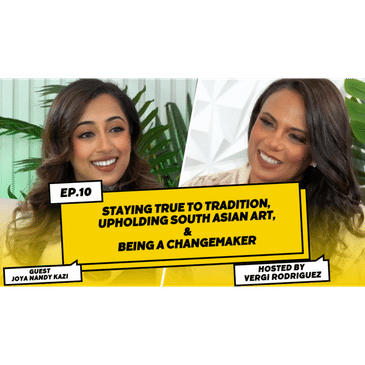
Joya Nandy Kazi just a Bollywood girl in a Hollywood World. A Creative Director & Choreographer, actress, dancer, educator and entrepreneur. Joya was born In Mumbai & Raised in the Bay Area. 3x Telly Winning Choreographer. Her work has earned her a spot on the DissDash list of Coolest South Asians. She choreographed for Mindy Kaling’s show “Never Have I Ever” on Netflix.
Creative Production Company Choreography & casting from stage to screen . She has also choreographed for shows like Nickelodeon's 'Monster High', FOX 'New Girl', and other shows on Disney & DreamWorks.
Joya founded her company at just sixteen years old, her work has earned her a spot on the DissDash list of Coolest South Asians.
A Race Of Your Own IG : / raceofyourown
Joya Nandy Kazi: IG : / joyakazi https://www.joyakazi.com/
Don't forget to subscribe. Thanks for watching.
Listen also on:
Spotify: https://open.spotify.com/show/3YOHILg...
Amazon Music : https://music.amazon.com/podcasts/0d4...
[00:00:00] Hi, and I'm Vergi Rodriguez, and this is A Race Of Your Own, where we talk about how inspiration leads to resilience.
[00:00:06] And today's guest is a creative director and a choreographer, an actress, a dancer, educator, and entrepreneur, born in Mumbai and raised in the Bay Area.
[00:00:14] She is a three-time Telly-winning choreographer. Her work has earned her spot on the Dishdash list of coolest South Asians.
[00:00:21] She choreographed for Mindy Callings' show, Never Have I Ever, on Netflix, and has a creative production company for choreography and casting for stage and screen, Joya Nandy Kazi.
[00:00:33] Yes! Welcome!
[00:00:35] Thank you. I'm so excited to be here.
[00:00:37] Yes, thanks for coming. You are one busy woman. Every time I see your social medias, you're somewhere doing something.
[00:00:45] Knock on wood.
[00:00:46] Yes, and choreographing, and then traveling, and then doing all kinds of things.
[00:00:50] Thanks for being here, producing all of it.
[00:00:52] I'm so happy.
[00:00:53] Oh my god, I feel so, like, blessed that you thought of me.
[00:00:57] Yes.
[00:00:57] Because obviously, I mean, if you guys don't all know, I mean, hello, OG, legend in her own right, right?
[00:01:04] Thank you.
[00:01:04] So to me, honestly, just even being on your radar and having this privilege to share space with you means a lot.
[00:01:10] Yes, of course, definitely.
[00:01:11] I mean, I think just from, like, the work that you've done is really what kind of stood out to me because of staying to, like, tradition when it comes to, like, your choreography, right?
[00:01:27] Yeah.
[00:01:27] And that's really important, I feel like, now more than ever.
[00:01:31] So knowing that, you know, you've done these really big projects, and then you're, like, have this weave of your tradition in that is really important, right?
[00:01:42] And a lot of what I talk about here is purpose.
[00:01:45] So how that kind of ties into kind of what you do.
[00:01:49] Right.
[00:01:50] Right?
[00:01:50] Yeah, I mean, it's definitely a struggle being in Hollywood and wanting to really just be all in with tradition and culture and upholding and elevating South Asian art in an industry that really doesn't know anything for it and know anything about it and doesn't necessarily have a space for it, which is fine, you know?
[00:02:08] It's not like I'm in India where you're going to have projects right and left.
[00:02:12] And that was definitely a huge struggle in the beginning.
[00:02:16] But, again, coming back to purpose is really what shaped the trajectory of my career.
[00:02:23] So I grew up as a student of the Indian classical art.
[00:02:26] So that's music and dance.
[00:02:28] So I grew up studying seven styles of Indian classical dance.
[00:02:30] I played seven instruments.
[00:02:32] Like, my life was just...
[00:02:33] What seven instruments?
[00:02:34] Flute, guitar, violin, the harmonium, which is like a piano accordion situation.
[00:02:42] I played piano, keyboards, tabla, which is like the Indian drums, Hawaiian guitar.
[00:02:50] Wow.
[00:02:50] And the reason being is because...
[00:02:52] A lot of stringed instruments, yeah.
[00:02:54] Yeah.
[00:02:54] I played the violin very briefly and I wasn't going to have it.
[00:02:58] But New York City public school system had a pretty good music program going on for a while.
[00:03:04] Yeah.
[00:03:05] But, you know, so Indian music and dance go hand in hand because the rhythms of the tabla
[00:03:10] or the bull is also the rhythm that you create with your feet.
[00:03:15] And so having that understanding really helped in my own just education of the arts.
[00:03:22] And I remember that when I started studying theater and dance at UC Davis, there was a very pivotal
[00:03:29] moment where I started understanding that even though I've studied all of these amazing dance
[00:03:35] forms that have been passed down generation to generation for thousands of years, survived
[00:03:39] the British rule, which really actually outlawed all of these, you know.
[00:03:44] And I've also been able to learn from the gurus and their, like, their disciples who have
[00:03:53] all helped create these lineages of dance.
[00:03:56] Just like in ballet, there's different methods.
[00:03:57] So there's different methods in certain Indian classical dance styles.
[00:04:00] And the family lineages that created these are the ones that I had the great privilege
[00:04:05] of being able to learn from.
[00:04:06] So even though I've done all of this and really, you know, if I wasn't in class at school,
[00:04:11] I was in sort of some sort of training.
[00:04:14] It didn't really count for seeing me as a dancer in my dance program because I hadn't
[00:04:20] done ballet, you know.
[00:04:22] And this is, again, like 15, 20 years ago.
[00:04:25] So things have definitely changed a lot.
[00:04:27] But I started going through this weird struggle of trying to figure out, do I need to prove myself
[00:04:34] to these people only in one way, which is learning ballet?
[00:04:38] And so, you know, I did what I needed to do.
[00:04:40] And I did the ballet.
[00:04:42] I started going to studios near school on top of that.
[00:04:46] And then I would switch dance training with other students.
[00:04:50] Like, I would teach them Indian classical and they would, you know, coach me in ballet.
[00:04:53] And so I was on point within two years.
[00:04:56] And I did all of that work, all of it.
[00:04:58] And still at the end, it was like, oh, you're an Indian dancer.
[00:05:01] So do you like do belly dance like this?
[00:05:04] And I was like, OK, I can either be offended or I can just be that person that's going to
[00:05:10] help share with people what it is that I do.
[00:05:14] And that was just that moment where I really realized that if I want to be seen and if I
[00:05:19] want to share with the world how beautiful Indian arts are, then I have to kind of really
[00:05:25] buckle in and say that this is what I'm going to focus on.
[00:05:28] And then moving to L.A. was difficult because, you know, I got meetings with agencies that
[00:05:32] got signed right away.
[00:05:34] They're like, we love your look, you're really commercial.
[00:05:35] And I was going out to like the Little Mama auditions, to the Katy Perry auditions.
[00:05:39] I was making it to the last cut.
[00:05:41] But then it was like at the Little Mama audition, you knew I'm the only one in the room that isn't
[00:05:46] black.
[00:05:47] And there's a vibe.
[00:05:48] Right.
[00:05:48] And then you go to the Katy Perry audition, you're one of the last six.
[00:05:51] And you look around and it's all white girls with freckles and red hair like she did
[00:05:56] at the time.
[00:05:56] And all of a sudden, there's me and one other like mixed girl.
[00:05:59] And you're like, they're only going to pick one of us.
[00:06:00] Right.
[00:06:01] Right.
[00:06:01] And so that was where the struggle happened of like, I got to put food on the table.
[00:06:07] But also, if no one knows what to do with me, I need to start creating my own opportunities.
[00:06:12] And that's kind of where, you know, pushing for creating the production agency, creating
[00:06:19] opportunities for other dancers, other South Asians really became my mission.
[00:06:23] I'm like, I don't have to be forefront all the time.
[00:06:25] But if in the casting room, in the important rooms where our stories are being told, where
[00:06:30] those opportunities are being created, if I can get myself into those places and show people
[00:06:35] that there is use of this art form in a very commercial way, then that's really, you know,
[00:06:42] the goal.
[00:06:44] Yeah.
[00:06:44] And it sounds like, you know, in that you found instead of taking what you were just
[00:06:47] telling that story about getting offended, instead of that, you kind of switch that,
[00:06:52] alchemize that.
[00:06:53] And we're like more like, well, maybe there's a purpose here.
[00:06:57] There's a lot of what I talk about here is purpose.
[00:06:59] Right.
[00:06:59] And finding that purpose within what you do and having that passion.
[00:07:03] Right.
[00:07:03] I feel like now more than ever, you know, telling our stories from our perspective is,
[00:07:09] whether that's through dance, whether that's through music or choreography, is really important
[00:07:14] to kind of maintain an integrity about it.
[00:07:19] Right.
[00:07:20] Because we're carrying who we are.
[00:07:23] We're carrying our families.
[00:07:24] We're carrying our traditions.
[00:07:26] We're carrying, you know, the things that make us unique.
[00:07:31] You know, that as much as many people might tap into that and watch that and they might
[00:07:36] watch, you know, your choreography, your pieces of work, they might, you know, take away from
[00:07:41] it something.
[00:07:42] But it's like no matter what, it's your culture.
[00:07:45] It's who you are.
[00:07:46] It's embedded in you.
[00:07:47] It's in your DNA.
[00:07:48] Yeah.
[00:07:48] And that can't be replicated.
[00:07:50] Right.
[00:07:50] That that can only come from you.
[00:07:52] And I think it's so important that people of the culture should be allowed to tell stories
[00:07:56] of their culture and share the dances of their culture or the music of their culture, because
[00:08:01] so often it's very easy to just keep working with the people that we know and just kind
[00:08:06] of moving forward.
[00:08:07] And, you know, it's it's the way it works sometimes where like you have a shoot, your shoot is in
[00:08:13] 24 hours.
[00:08:13] Like you just got to get everyone together and make it happen.
[00:08:16] Right.
[00:08:16] But taking a moment of pause to say, let's at least bring someone into the room that knows
[00:08:21] something about this so that we are delivering the right message, especially now it's 2024.
[00:08:25] Like it's time it happens, you know, that's so important.
[00:08:29] And just what you're saying about that, this is who you are and identity for any artist
[00:08:33] is such a it's like a cornerstone of everything that you do.
[00:08:38] And so for me, having been born in India, but moving here before my first birthday, it
[00:08:43] was very weird because I I'm all in all through and through American, like I'm a California
[00:08:49] girl, like I don't fare well under 70 degrees.
[00:08:52] Like I'm good with about 70 degrees.
[00:08:55] I'm out.
[00:08:56] Time to wear a scarf.
[00:08:57] Time to put on a jacket.
[00:08:59] You know, like grew up going to the baseball games, doing all of that.
[00:09:02] But then also going to my Indian classical dance trainings and all this.
[00:09:07] But it was this weird thing that because even in the Indian community here, people knew
[00:09:11] that I was born in India.
[00:09:12] It was almost like she's too Indian.
[00:09:15] But then I'm like, I'm not American enough.
[00:09:18] And when I go back home to India, she's way too American.
[00:09:22] Right.
[00:09:22] So couldn't really find where I fit there.
[00:09:25] And then also just within the South Asian community, I come from, you know, parents of
[00:09:30] different faiths.
[00:09:31] So my parents ran away and got married.
[00:09:32] My mom is a Bengali and Hindu.
[00:09:35] My dad is Kashmiri and a Muslim.
[00:09:37] So we grew up going to church, going to the mosque, going to temple.
[00:09:42] Like my mom has a very big faith in Jesus.
[00:09:45] And so like we grew up going to all places of different faiths.
[00:09:50] But even there, it was like, oh, no, she's a half blood.
[00:09:54] She's not, you know, like she's not any one of us.
[00:09:57] And so in our home, there also wasn't a very strong tie to one specific religion where
[00:10:03] we went to go pray.
[00:10:04] You have the Quran.
[00:10:06] You have the Bible.
[00:10:07] You have the Gita.
[00:10:08] You have gods of all faiths.
[00:10:11] We have a Buddha.
[00:10:12] And it's more of taking the best from all of these.
[00:10:15] So I feel like for me, when it came to dance, dance was the space where I found that discipline
[00:10:21] and almost the sense of religion within my dance.
[00:10:25] So that's kind of how I grew up is that just all the beautiful values of all these cultures,
[00:10:30] all of these faiths together.
[00:10:31] And then being able to apply that in my discipline and the way I approached the arts and the respect
[00:10:39] for it.
[00:10:40] So when I'm bridging the commercial world with the Indian classical world or the traditional
[00:10:45] world, I do.
[00:10:47] I'm very mindful of the fact that I want it to be viable to the West and accessible without
[00:10:54] stealing the root of it and the dignity of it.
[00:10:57] And I want something where people back home will say that they're proud of it, just like
[00:11:02] people here are intrigued by it.
[00:11:04] And it's an interesting line to play across.
[00:11:10] But it's all about just staying true to who you are at the end of the day and putting your
[00:11:15] best foot forward.
[00:11:16] Yeah.
[00:11:16] I think it's, you know, I'm hearing you say it's like balance.
[00:11:19] It's like finding that balance and then finding the discipline to really stay true to the
[00:11:27] story you're telling, so to speak.
[00:11:29] Right.
[00:11:29] Because the story you're telling isn't only just a piece of choreography that you might
[00:11:33] put together or production that you're putting together, but it's also like who you are
[00:11:38] day in and day out.
[00:11:39] Right.
[00:11:39] Like what are you adding to your story?
[00:11:42] Yeah.
[00:11:42] On a daily basis.
[00:11:43] Exactly.
[00:11:44] And in addition to that, right, you will never lose who you are.
[00:11:48] I when people ask me, like, who are you as a choreographer?
[00:11:51] I'm like, who am I as a choreographer?
[00:11:54] What is the answer to that?
[00:11:57] But when I really think about it, I'm a culmination of all of my guru's teachings, the stages that
[00:12:04] I've had the opportunity to be on and those experiences from that and my mom's blessings.
[00:12:09] Like between those three things, that is who I am as a choreographer.
[00:12:13] It's the teachings, the experiences and mom's blessings.
[00:12:16] So that will never leave me.
[00:12:18] That is within me.
[00:12:19] Now, my job as a creative is that as I take all of these things with me, I also have to
[00:12:25] deliver well on the job.
[00:12:27] So for example, when I came into choreographer Saweetie, who is fun, sexy, gorgeous rap artist,
[00:12:35] I can't put her in the avatar that necessarily is 100% traditional.
[00:12:41] I need to make sure that what I give her matches her vibe, her brand, who she is.
[00:12:47] But we're also bringing the aesthetic of the traditional.
[00:12:51] And she really was inspired by Bollywood music and Indian hand gestures.
[00:12:57] But I also have to be careful about how we're treating that because those are temple dances.
[00:13:01] So actually creating new hand gestures that would just specifically be for her without
[00:13:07] being offensive, but also giving her what it is that she wants is where the creative
[00:13:12] part comes in.
[00:13:13] Right.
[00:13:13] Like giving her that authenticity where it doesn't look like it's appropriation.
[00:13:18] Exactly.
[00:13:19] Because even on that end, right, it could be considered appropriation, but it's authentic
[00:13:22] to her and fits her and her brand, her style, like you're saying.
[00:13:26] So it's like who you are will never leave you.
[00:13:28] But in entertainment, as I go back and forth between Bombay and here, the work has to change
[00:13:34] and you need to mold it in a very craftful way, especially when you're working with tradition.
[00:13:39] Yeah.
[00:13:40] And I kind of, and I didn't say this in your intro, but I love your tagline on Instagram.
[00:13:45] You're like Bollywood girl in a Hollywood world.
[00:13:47] In a Hollywood world.
[00:13:47] I love it.
[00:13:49] It's like, I was like, oh, I wanted to introduce you as that.
[00:13:51] But, you know, and you founded your company when you were just 16 years old.
[00:13:56] Yeah.
[00:13:57] Wow.
[00:13:57] Wow.
[00:13:58] Like how?
[00:13:59] Yeah, I know.
[00:14:00] Right.
[00:14:01] Like you were still in high school.
[00:14:02] Yeah.
[00:14:03] So basically when I was 12 years old, my parents took me to this huge Bollywood concert.
[00:14:08] And at these, these concerts, essentially you have like the A, like the A-listers of Bollywood
[00:14:14] who come out and they perform their greatest hits from their films.
[00:14:18] And, you know, most of our films are musicals.
[00:14:20] So it's all about seeing those amazing celebrity actors and the dance and the music and all of that.
[00:14:26] And while I was watching the show, my mom pointed someone out on the side of the stage because
[00:14:29] we could see him through the wing.
[00:14:31] And his name is Shah Makhdavar.
[00:14:32] And he's a very famous choreographer who's credited with bringing ballet in contemporary
[00:14:37] to India.
[00:14:38] And so he was really big in film choreographies, you know, throughout the 80s and 90s.
[00:14:42] And then all of a sudden that thought was planted in my mind that, wait, this is his job.
[00:14:50] And now I'm looking at all of these dancers and these gorgeous out, out of life props.
[00:14:57] He's known for having just these crazy, huge, gigantic, uh, costumes and costumes.
[00:15:04] Yeah.
[00:15:04] All of this.
[00:15:05] And it's like this person thought of all of these things and I'm seeing the dancers.
[00:15:08] I'm like, they probably travel the world and they go like city to city.
[00:15:12] They're here performing for us.
[00:15:14] I wonder how they see their families.
[00:15:15] When do they go home?
[00:15:16] And then you look, all of a sudden I'm not paying attention to the celebrities.
[00:15:19] I'm paying attention to the dancers and they're just, you know, dancing full of life.
[00:15:25] The hair is flipping and the sweat is dripping.
[00:15:27] And they're just like, you just see joy.
[00:15:29] And in that moment I was like, I want to be a choreographer.
[00:15:35] Like I want to create these things and I want to show people my culture.
[00:15:39] And so that was at 12 years old.
[00:15:41] And when I was driving home in the car with my parents, I told them in the car, I made
[00:15:45] the announcement that, uh, I've decided mama and daddy that when I grow up, I want to be
[00:15:50] a choreographer.
[00:15:51] And what do they say?
[00:15:52] And so I can, I remember like my dad just like looking up into the rear view mirror and
[00:15:56] my mom kind of looking, they're looking at each other.
[00:15:58] Now keep in mind, okay, my dad was a model and actor in Bombay.
[00:16:02] My mom is a journalist and that's how they met.
[00:16:05] And once I came along, unfortunately my godfather told my dad that he needed to get a real job.
[00:16:12] And my dad was doing very, very well.
[00:16:14] I think he would have gone very far, but unfortunately they didn't have the privilege and the opportunity
[00:16:20] to be able to, you know, be in, be like 19, 20 year olds with a little kid and also pursuing
[00:16:26] things in entertainment.
[00:16:28] Right.
[00:16:28] And so they come from that background.
[00:16:31] And then they, when they moved here, they moved here without a single friend or family
[00:16:34] here in the country.
[00:16:35] It was just these two little kids with a little baby and they were trying to make it, you
[00:16:39] know?
[00:16:39] So they also understand that dream, but then also as parents have that concern of what is
[00:16:47] the viability of this career, the financial stability.
[00:16:50] But they, they paused and they said, look, whatever you want to do in your life, even
[00:16:55] if you want to be a janitor, just be number one.
[00:16:58] You have to work really hard no matter what.
[00:17:01] It's not an easy road.
[00:17:02] It's going to be more difficult than being a doctor, lawyer, engineer because there's
[00:17:05] no set path.
[00:17:06] But whatever you want to do, you have our love and support, but you have to work hard.
[00:17:12] And that was it.
[00:17:13] And so then after that, I went to my first guru who is my, um, I call her Jyoti Appa,
[00:17:19] which means like, um, elder sister.
[00:17:21] So Jyoti Raut is my very first dance guru.
[00:17:25] So I went to her and started asking her if, uh, she wouldn't mind if I would shadow her
[00:17:29] and just come and help in other rehearsals.
[00:17:30] Cause I wanted to start understanding this process of creating, choreographing, teaching.
[00:17:35] And I had many dance teachers who allowed me that opportunity to kind of step into the
[00:17:40] room, shadow them, learn, and then offered me opportunities to choreograph and create.
[00:17:45] And as that was happening from 12 to 16, I really started like honing in on like what
[00:17:49] it is that I want to do, what I want to create, who am I as a choreographer.
[00:17:54] And then I was like, it's time to, you know, make it happen.
[00:17:59] And so for my 16th birthday, my mom told me that, uh, my gift was that she was going
[00:18:04] to drop me off at the mall to go get a job.
[00:18:07] And I was like, what?
[00:18:09] What do you mean?
[00:18:10] That's my gift.
[00:18:11] And she's like, well now you're, you're 16 years old, you know, it's time for you to
[00:18:15] go and earn your own money and you can do whatever you want with your money.
[00:18:18] Go make it happen.
[00:18:19] I'll drop you off and make it happen.
[00:18:21] And so I was like, okay.
[00:18:22] And I went and I got a job at Abercrombie and I, I, um, I spent like the first month there
[00:18:28] and I was like, what am I doing with my life?
[00:18:29] I don't want to be here.
[00:18:30] I want to be dancing.
[00:18:31] I want to be creating.
[00:18:32] I want to be teaching.
[00:18:32] So I was like, I'm going to just start my own company.
[00:18:35] Like, let's make it happen.
[00:18:35] So I made a flyer on Word document, went around, posted it up all over the community
[00:18:41] at like the community center, at the libraries, started teaching classes.
[00:18:44] And that was kind of the start of it.
[00:18:47] Wow.
[00:18:48] I hear like a, a similar story of someone I know very well that at a young age as well,
[00:18:54] a kind of, for me, you know, I knew, uh, what I wanted to do and it, and it, you know,
[00:19:00] a lot of what I talk about here is purpose.
[00:19:02] And for me, that point, and I always remember it was watching, um, you know, the original West
[00:19:08] Side Story on, on, on, on TV.
[00:19:10] It was like on TV or something.
[00:19:12] And I remember like pointing to that and being like, that's what I want to do.
[00:19:17] You know, when it comes to culture, because, you know, it was like the Puerto Ricans, the
[00:19:22] Jets versus the Sharks and, you know, the Puerto Rican and the, that, you know, white
[00:19:25] American story and like that, what it was.
[00:19:27] And I was like, I want to do, you know, I want to be Anita.
[00:19:30] Like that's, I want to do that, you know?
[00:19:32] And it's, um, it, I definitely think it's like a gift, right?
[00:19:36] But, um, it, it's, um, purpose.
[00:19:39] I feel.
[00:19:40] And sometimes as a kid, we don't really know that.
[00:19:42] Right.
[00:19:43] We're just like, we're just like, well, I just, I just want to do that.
[00:19:45] I just want to do it.
[00:19:45] Yeah.
[00:19:45] But, but to me, it was, uh, about representing, representing my, my culture, my background,
[00:19:53] you know, my people, so to speak in that sense.
[00:19:56] And your experience.
[00:19:56] And my experience.
[00:19:57] Yeah.
[00:19:58] And the importance of that.
[00:19:59] So I kind of hear that through line too, is you as a child saw that in that choreographer
[00:20:03] and you were like, there, that's what I want to do.
[00:20:06] I feel like it's, it's like a very magical blessed moment that you just, you don't even
[00:20:11] know what the meaning of it is.
[00:20:13] Right.
[00:20:14] And so for me, I mean, once I was like 12 and onwards, then I started understanding who
[00:20:19] I am culturally also in a space that doesn't understand it.
[00:20:22] But the way that I even started dancing is because of Michael Jackson's black or white
[00:20:27] music video.
[00:20:27] And so I was like three and a half, four years old when it came out.
[00:20:30] I remember, I mean, I was already just so obsessed with Michael.
[00:20:34] I mean, who is it?
[00:20:35] Right.
[00:20:36] And, um, like my mom would wake me up at like 10 or 11 o'clock at night to just to be able
[00:20:41] to watch his one video on MTV.
[00:20:43] She's like, you can get up to watch this.
[00:20:45] Cause I was just like that passion for Michael, you know?
[00:20:47] And so in the black or white music video, he dances with an Indian classical dancer and
[00:20:52] the style she does is odyssey.
[00:20:53] And, um, when I saw that, I mean, I was so mesmerized and this is also why, you know,
[00:21:00] we really harp on like, why is representation important?
[00:21:02] And I feel like we've really just like drilled to this answer, but it's so, it really is so
[00:21:07] meaningful because that was the first time that I had ever seen an Indian classical dancer,
[00:21:13] not from an Indian movie, not from my community, not at like community events.
[00:21:18] I saw it in a Michael Jackson music video, an Indian dancer, dark brown skin, bindi, big
[00:21:24] eyes, just like me, you know?
[00:21:27] And in that moment I told my mom, I want to do that.
[00:21:31] Now the reason was cause I thought that if I did that, I could then marry Michael Jackson,
[00:21:37] not just me.
[00:21:38] We're going to marry him and travel the world for him.
[00:21:40] Right.
[00:21:40] Like that was the end.
[00:21:41] You're like, that was the thought process, you know?
[00:21:44] Right.
[00:21:45] And then, um, a couple of months later, my first dance teacher that I told you about
[00:21:50] Jyothi Rao, she is an Odyssey artist.
[00:21:52] So that is actually how I started my dance career is seeing the Indian dancer in his video
[00:21:57] that began my dance career.
[00:21:59] And that was like the influence of popular culture too.
[00:22:02] Right.
[00:22:02] Like, like the fact that he understood, uh, the assignment, so to speak.
[00:22:07] Yes.
[00:22:08] Everybody likes to say that, but, um, he really understood, um, the importance of like culture
[00:22:13] and representing cultures.
[00:22:14] And making sure that the dancers that he brought in were of the culture.
[00:22:18] And it wasn't, uh, it wasn't a diversity play, you know, in that sense where it was
[00:22:23] just like, he was like, no, I want to do this thing.
[00:22:25] Cause he was such a creative, you know, and rest in peace, Michael.
[00:22:28] I mean, I, Michael Jackson, I always talk a lot about his influence on popular culture
[00:22:32] and like dance, um, because he was such a, uh, I talked about this before when he was,
[00:22:37] um, I think it was a Bob Fosse movie and I think it's called the little prince where
[00:22:41] he took that snake dance.
[00:22:43] Um, and he made it, he made it his own, you know, the high water black pants with the white
[00:22:47] socks with the loafers come from a Bob Fosse movie, but he so made it his own.
[00:22:52] And he was such a, uh, magnetic kind of force in that sense where he just, he, he just transformed
[00:22:59] things and made it into his own.
[00:23:00] So made it his own.
[00:23:01] Exactly.
[00:23:02] For you to see it.
[00:23:02] And for your mom to be so supportive of like being like, cause my mom would do the same
[00:23:06] thing.
[00:23:06] It's just like Michael Jackson's on the TV.
[00:23:08] And I'm like, Oh my God, you know what I mean?
[00:23:09] I gotta go watch it.
[00:23:11] Um, and, uh, you know, he had that kind of influence on us.
[00:23:15] And I think if you really wanted to take dance seriously, he was one of the people in our
[00:23:21] times.
[00:23:21] Right.
[00:23:21] Cause even before that there was, yeah, the Ben Vereens and the Eugene Kellys and the Fred
[00:23:26] Astaire's, you know, you know, the greats.
[00:23:29] Um, but he kind of classic sense in a classic sense, but then he kind of, he, he, he, he like
[00:23:35] put it and made it like this cool thing.
[00:23:38] Right.
[00:23:38] And then he like added popping and locking, um, just kind of gave birth to this whole new,
[00:23:43] this whole new way of looking at dance and, and really performance, performance story
[00:23:48] behind it.
[00:23:50] All of it.
[00:23:50] Yeah.
[00:23:51] Yeah.
[00:23:51] Fun fact.
[00:23:52] My birthday is Michael Jackson's birthday.
[00:23:55] Is it really?
[00:23:56] Yeah.
[00:23:56] August 29th.
[00:23:58] August 29th.
[00:23:59] Yeah.
[00:24:01] That's crazy.
[00:24:02] I know.
[00:24:02] That's awesome.
[00:24:03] Talk about kismet.
[00:24:05] Yeah.
[00:24:05] Yeah.
[00:24:06] That's awesome.
[00:24:06] No, that's great.
[00:24:07] Um, you know, I, Michael, Janet have had such for me.
[00:24:12] I actually just got to see her perform.
[00:24:14] Um, I went to her concert earlier this year, just a couple of months ago.
[00:24:18] And then, and I never had the opportunity to actually see Michael live.
[00:24:22] And like, that was the closest thing to it.
[00:24:25] And I, I just feel like this is really, you know, kind of going off our original topic,
[00:24:31] but just the, the, the music artists that were, that existed in like the eighties and
[00:24:37] the nineties and the early two thousands, like they just don't make them like that anymore.
[00:24:41] There's just this different feel and you just get transported.
[00:24:44] And I was like, why do I feel like, like we work on so many, we've worked with so many
[00:24:49] celebrities and you're very like, you know how to act professional.
[00:24:52] But when I was in that room, I was like, yeah, I got to see her.
[00:24:57] Was it this past year?
[00:24:58] Last year, uh, in Arizona with some friends with Brian Friedman.
[00:25:03] He kind of made that happen and he had worked with Janet for a long time and, uh, he had
[00:25:07] a barbecue and she came over and I was like, I can't believe I'm like, Janet Jackson.
[00:25:13] Like, and I was like staring at her and I was like, don't stare, don't stare.
[00:25:16] Like I was trying not to stare.
[00:25:17] Um, and I had worked with her before on a music video too, very briefly.
[00:25:20] But you know, she, when we went to the show, you know, uh, I just was like, she doesn't
[00:25:28] age one and two.
[00:25:29] She just like was hitting the choreography.
[00:25:31] Cause the first tour I've seen of hers was Velvet Rope.
[00:25:34] Oh, and that, that tour, that show, I just was like, that was like iconic for me and
[00:25:39] transformative for me to see.
[00:25:41] But then years later to see her on this last tour and I just was like, she's still
[00:25:45] like hitting that choreography.
[00:25:46] She's making it happen.
[00:25:47] And, and I was still just as inspired.
[00:25:49] I was still just as like, Oh my God, it's transformative for me.
[00:25:51] I can't believe it.
[00:25:52] And then I got to meet her and I was like, ah, you know, again backstage.
[00:25:55] Like she's like, hey.
[00:25:56] I think what's so inspiring, especially about those types of artists too, is also just the
[00:25:59] longevity of their career.
[00:26:00] And that's something that every artist needs to think about.
[00:26:03] I feel like the, one of the things that helped me out very early on is that I realized that
[00:26:09] being an artist and having a career as a choreographer or a dancer, you have to look at it as a business.
[00:26:16] And that's something that a lot of times people kind of overlook cause you're just so you're,
[00:26:20] you're training and you're in the creative space and you like just want to do your art.
[00:26:24] But then when you focus on branding and who you are and, you know, everything from down to like costume design
[00:26:32] and the color palettes that I use, um, the way that my dancers are styled, the way that they walk,
[00:26:38] the way that they are seen every, every single, you know, minute detail down to the marketing and who we are.
[00:26:45] Those are the things that really created the brand.
[00:26:47] And then going beyond that longevity, like I'm not going to be able to dance forever.
[00:26:53] I have, I've had a busted knee for now two, three years and it's not something that's going to get better.
[00:26:58] It's only going to get worse with age because it's just wear and tear. Right.
[00:27:01] So, but we don't age, we don't age.
[00:27:04] We don't age.
[00:27:06] We don't age.
[00:27:08] But you know, that was the other thing too is like, okay, I can't be a dancer forever and I can't, you know,
[00:27:13] maybe a choreographer. Yes.
[00:27:15] But then I also got to a certain point where, you know, knock on wood,
[00:27:19] I really feel like I got to a point where we really did the work.
[00:27:21] Like it was out there, you know, it was on television shows and music videos and commercials,
[00:27:26] the brand partnerships.
[00:27:27] And like we're, we're getting people out there and people see it.
[00:27:30] And that, that, that snowball will never stop rolling.
[00:27:34] But I got to a point where I started feeling like I kind of want more challenge.
[00:27:38] I want to do more and learn, you know?
[00:27:41] So exploring as a director, as an executive producer, as a creative director,
[00:27:44] now working with ad agents, ad agencies to create brand partnerships that are more inclusive to the South Asian culture.
[00:27:52] All these different things, just really trying to push myself to go outside of my comfort zone and learn new skills.
[00:27:59] So that when I'm 90 years old and hopefully the other knee will be good,
[00:28:03] but if they're not, I can still be working and still feel purpose.
[00:28:07] Yes. And having, you know, it sounds like to me, it's like advocacy is important to you too, you know?
[00:28:13] And, and again, it's like, we don't want to say it's like this diversity play because it starts to feel,
[00:28:20] excuse me, it starts to feel like forced, right?
[00:28:22] And it starts to feel like that's just, it's like, no, it's like, that's just who we are.
[00:28:26] And, and there's still like stigmas around that.
[00:28:28] And there's still, you know, who's telling our stories?
[00:28:30] And I, you know, you know, and for the audience too, it's just like a big thing.
[00:28:34] It's like, you know, the feedback that I've been getting, which has been great, has been like, yeah, no,
[00:28:38] I love watching it because it's so informative.
[00:28:40] And it's like, we just need to keep telling our stories, right?
[00:28:42] We just need to be out there.
[00:28:44] And sometimes, you know, it lands on us, right?
[00:28:47] Which then feels like, oh, I have a responsibility, you know?
[00:28:51] And, and you try to dip and dabble between purpose and responsibility.
[00:28:55] And I think that's, that's a really interesting thing that you bring up because that's not a responsibility.
[00:29:00] That everyone has to take on.
[00:29:02] And it's a, it's, and I don't expect everyone to take it on.
[00:29:05] It's a huge decision.
[00:29:06] I mean, when I said before that I had a moment where I could be offended or I could take it upon myself to do the work,
[00:29:14] to teach, to educate with kindness and love and understanding, getting my feelings hurt along the way,
[00:29:21] feeling belittled along the way, feeling underestimated along the way,
[00:29:25] but still showing up with a smile to do it.
[00:29:27] And it's not, it's not an easy thing.
[00:29:29] And not everyone has to do it at all.
[00:29:33] And there are a lot of people who decide like, that's not like, I'm not here to keep educating in 2024.
[00:29:38] Like, it's just not for me.
[00:29:39] I'm going to go the TikTok route.
[00:29:41] I'm making my money.
[00:29:42] It's happening.
[00:29:43] I've got my followers.
[00:29:44] We're set, you know?
[00:29:46] And there's, there's no right or wrong to that.
[00:29:49] It's just, it's just two different paths.
[00:29:51] But I just feel like it was within me and I had the capacity to do it.
[00:29:58] And so that's why I'm here.
[00:30:00] And yeah, not being offended is definitely one of the things that can make or break that process.
[00:30:07] Um, and you have to tread the line and understand when is it appropriate to put your foot down and say,
[00:30:14] okay, guys, this, this time we need to make it a point to address the fact that
[00:30:21] why were there no South Asians in the room when the entire project was about South Asians, you know?
[00:30:27] Right.
[00:30:27] So it takes time, but I will also say that I'm very lucky in that, um, I, there are people in the industry,
[00:30:36] you know, to Zonda Chavez, Christian, you know, there are people who really yourself who allow me
[00:30:43] to come into space and take up space and to voice my opinion and just be who I am as a creative.
[00:30:49] And that in itself, um, when you kind of look back and give a helping hand to someone and you just help
[00:30:54] them come through the door to be able to say that, that actually helps push that narrative forward
[00:30:59] and that conversation forward so that when there are issues, at least we can have that conversation
[00:31:04] and be like, Hey, I understand what the restrictions were X, Y, and Z. However, we have these resources.
[00:31:12] Um, you, and it doesn't have to be me. It can always be somebody else that we can bring in.
[00:31:16] Right. I'm not saying that I'm the only one person that can do that. There's plenty of us,
[00:31:20] but just sometimes we need to make a little more effort to just reach into that community
[00:31:28] for it to make sense, you know? Um, but yeah, it's, it's definitely something difficult. And I,
[00:31:34] I know, uh, you know, Reshma Gajar. Yes. And so Reshma and I grew up in the same exact town,
[00:31:39] like two blocks away from each other. Yeah. I don't know. I love Reshma. Hi Reshma. Shout out to
[00:31:44] Reshma. Okay. Yeah. And so, you know, there, we had, um, there was definitely, there've been some
[00:31:49] projects where she and I will jump on the phone and she's like, but joya, like, I know these people,
[00:31:54] I know who's in the room. Like I could make a call and like, I could explain it to them,
[00:31:57] but I just, I don't know if I need to be the one to do that. And also for her, because she's an OG
[00:32:02] as well. Like she was the one and only Indian girl in all of LA, you know, for a very, very,
[00:32:10] very long time. Yeah. But it's like, you can't just have one token girl. And it's like for her,
[00:32:14] now she's in a space where she wants to move forward and challenge herself and grow as well as an
[00:32:19] the space. And there's no one else that we're going to consider at all. Then that becomes an
[00:32:26] issue, you know? So it's, it's a difficult thing. Like sometimes you just, you get tired,
[00:32:30] which is okay, which is fine. But I think having, um, having allies in the space who recognize it and
[00:32:37] can just be like, hold on guys, two second pause. Let's bring somebody in. If we don't know who,
[00:32:42] we know people who can help us bring in the right people.
[00:32:45] Right. Right. And, and sometimes just being in that space of acceptance, right? And just being
[00:32:53] like, okay, well, this is what it is. You know, you look around and you're like, you know, who are
[00:32:58] the people in the space? What are they saying? What's the narrative? Um, can I shift this narrative
[00:33:04] into a positive, right? If it's negative, um, and, or if there's, um, something that's being said
[00:33:10] that isn't true or that is, um, unsettling or, or whatever, whatever it is, right?
[00:33:16] Sometimes people just don't know the nuances of things that can actually come off as not,
[00:33:21] not even slightly offensive, but it's like, it's vulgar. You know, there's a lot of things like
[00:33:25] that.
[00:33:25] Or people do know that it's vulgar and they know what they're doing. And sometimes you just have
[00:33:28] to be like, Oh, okay. I see you. Check me. You know what I mean? And, and just, or just live in
[00:33:35] your truth because what happens is, and, and, um, you know, no matter I, there was a quote I put up
[00:33:40] on some Instagram post. I don't know where I pulled it from, but I read it somewhere and I was like,
[00:33:45] this is smart. And it was like something like, you know, no matter what lies people say of you,
[00:33:50] um, always live in your truth. Like, like, like if, if you're living in your truth, no matter what
[00:33:54] anybody says, like the lies will just kind of fall by the wayside. Um, and I think that that's
[00:34:00] what we're moving into and other guests that I've had, you know, on here talking about, you know,
[00:34:05] authenticity, right. And being in a space where, you know, consumers, what they're consuming,
[00:34:10] they want to see someone like yourself who is of the culture telling that story from whether it's
[00:34:17] dance or music or producing an event, directing, like whatever it is, like, I want to see it from you.
[00:34:24] You know, uh, crazy rich Asians is such a great, um, example of that, you know, from a movie standpoint,
[00:34:31] like everybody's family has every single one of those characters in their family. Right. And it
[00:34:36] didn't matter whether the family was Asian or black or Latin or, you know, whatever East Asian, like
[00:34:40] South Asian, whatever. It didn't matter. Like it, it, we, we, we get it. Right. And only those
[00:34:46] storytellers, those filmmakers, filmmakers could say it just like yourself. Like I want to see a story
[00:34:51] from joy. Yeah. And I think the thing is that a lot of times people think when it's something
[00:34:56] that's community based, that it's, it actually is alienating. However, these are all universal
[00:35:01] values. These are the universal themes that everyone can relate to. It's just that we're also trying to
[00:35:07] push, uh, push everyone into this space. Now, you know, again, it's like, it's not for DEI and all of
[00:35:14] that, you know, it, and I, I do think that it's got to make sense because also for people from the
[00:35:19] community, we don't want it to just be DEI because we've worked really hard to get to this point that
[00:35:25] if I'm going to get the job and I'm going to be in the room, it should be based off of my own merit.
[00:35:29] Yeah. Like I don't need the DEI hire. It's not necessary. However, in certain spaces, it is
[00:35:35] important to, to help shift the perspective and understand like, hold on a second, we are not
[00:35:41] being inclusive and it's not, it's actually taking away and detracting from our goal together,
[00:35:46] you know? So yeah, I mean, moving across different spaces, like I just did, um, a collaboration with
[00:35:54] AARP. So originally they wanted to do a collaboration with me to try to tap, tap into like the younger
[00:36:00] South Asian crowd. And I was like, wait, we never get to see our older generation. We never get to
[00:36:06] see, you know, the aunties who are dancing and looking like the beautiful Bollywood stars all the
[00:36:12] time. So let's kind of, let's the rich aunties, the rich Asian aunties. Yeah. And so it was really
[00:36:19] nice. I was able to bring in, um, you know, professional artists of the Indian classical
[00:36:25] arts and also Ranjita Chakravarti who plays the grandma on never have I ever and have her be in
[00:36:30] it as well. And it was for the volley campaign. So just really sharing this idea of togetherness
[00:36:35] and family, but also that not only is it important to embrace your own inner light during the volley,
[00:36:40] but also help reignite the light of those around us. So this idea that, you know, even at the cast
[00:36:47] was like 70, 80, you had someone that was 90 years old that even at that age that they also need the
[00:36:54] support and a little bit of encouragement, just like we do for our kids in the younger generation
[00:36:57] that we want to be able to give that to them. I mean, they're starting new careers at 60, 70 and 80
[00:37:03] years old. It's, it's, it's a great thing. Like what I'm seeing and it's like, I I'm seeing,
[00:37:09] you know, younger generation saying, no, I want to, I want to hear from the OGs. Yeah. I want to
[00:37:14] hear, I want to hear from the older crowd. You know what I mean? I don't care about all this other
[00:37:18] stuff. I want to hear from them. What do they have to say? Cause that's where all the wisdom is,
[00:37:22] right? There's so much wisdom there. And I really think people are out there wanting wisdom,
[00:37:27] hungry for that type of wisdom. And it's so great now that like we can actually create that space.
[00:37:32] So that's also one of the things that I do. Like, you know, sometimes I'll get certain contracts
[00:37:36] and I will say, well, if you want to work with me, you have to work with my dancers as well.
[00:37:40] You know, and I'm open to casting other people, but we need to get some of the like brown bodies
[00:37:45] into onto the screen or onto that stage. Or if we're doing something for AARP, it's cool for me
[00:37:51] to just kind of like take that collaboration for myself, but then let's make it more meaningful.
[00:37:55] And like, we don't get to see the older generation, that older South Asian generation,
[00:37:59] because most of them, you know, they immigrated here. They didn't have that privilege of exploring
[00:38:04] the arts and creativity. It was really about, you know, we've made all these sacrifices for our
[00:38:08] families. We got to be successful. We have to make it happen. So now let's, let's open up that
[00:38:13] opportunity for them and have them come be a part of it. And that just makes the work so much more
[00:38:17] meaningful for me, you know, and right now I'm, um, kind of preparing for, um, well actually,
[00:38:25] so right now I have two shows that are coming to Disney festival of holidays and they're for the
[00:38:31] celebration of Diwali and one celebrates through dance and the other one through Indian classical
[00:38:36] music. Where's that? Is that going to be? It's going to be at California adventures. Um,
[00:38:40] yeah. And we are, our first show is actually tomorrow. What? Yeah. Oh my God. And does it run
[00:38:46] through the holidays? Yeah. So during their festival of holiday season, we have specific dates for both
[00:38:51] the shows. Okay. So one until the new year or yeah, it's going to go, the holiday season goes
[00:38:56] November 15th till January 7th. Nice. So we have a couple of show dates throughout that. So the first
[00:39:03] show, the light within, it's basically this idea that there's one character who's via or her tea
[00:39:09] light. It's the only one that doesn't light up. And so she goes on this journey with her friends who
[00:39:13] try to help console her and show her that there's more to the festival of lights than just the light
[00:39:18] and how different people, different States in India celebrate during Diwali, what the traditions are
[00:39:22] also introducing to different types of Indian music, whether it's classical folk, Bollywood,
[00:39:27] Tollywood, which is the South Indian cinema. And through that, she talks about how she does community
[00:39:33] service with her grandmother, her nani and brings gifts for her friends. And in that moment when she's
[00:39:38] thinking about others and not so much about her own light, her via her tea light. How beautiful.
[00:39:45] You know, so it's a really magical way to explore the idea of Diwali.
[00:39:50] That's amazing. Disney needs to expand that. Disney needs to bring that to Hollywood. We need to see
[00:39:57] that. We need to see that on screen and we need to see that as a live show.
[00:40:02] From your lips to God's ears, like let's make it happen.
[00:40:04] We're the Disney gods. Are they listening?
[00:40:07] Yeah.
[00:40:07] That is beautiful.
[00:40:08] I'm really, really excited about that. It's just kind of, again, being able to introduce
[00:40:12] audiences, international audiences into this culture where they're not just spectating,
[00:40:17] but they actually can come into it and feel it. And it's the same thing with the other show.
[00:40:21] The other show is called Rangoli Rhythms. Rangoli is the powdered designs that we make on the floor.
[00:40:28] They're really beautiful, intricate, like mandala designs. And we make them for good luck and to
[00:40:32] invite prosperity into our home. And so in this, we have, we are featuring instrumentalists who are
[00:40:40] all of the Indian classical world. So we have a sitar player, a tabla player, a sarangi player,
[00:40:47] and two phenomenal singers. And they actually are joining the world of Disney and Indian classical
[00:40:54] music. So you'll hear Disney classics in English with Indian instrumentation and then also in Hindi.
[00:41:01] And there's a fun interactive where people can follow along with the rhythms that are made by
[00:41:06] the instrumentalists. It's just a really fun. And that's also at the California Adventure.
[00:41:11] Exactly. So it'll be during the Christmas season too.
[00:41:13] Exactly. Amazing. Congratulations. That's great. Yeah, I have to come check out the show. So we'll
[00:41:18] talk about that later. But yeah, I totally want to go see this tour. Oh my God, it's exciting.
[00:41:23] I'm so excited for you. So one thing I wanted just to kind of wrap up is like, you know,
[00:41:27] what I talk about on the show is being in a race of your own, which you obviously exemplify that,
[00:41:30] right? Just being in a race of your own, taking that decision, taking that initiative to tell your
[00:41:34] story from your perspective. Sometimes there's hills, valleys, plateaus, tumbleweed times.
[00:41:39] What would you say as like just one thing for, you know, the viewers watching would be one thing
[00:41:45] that you would kind of give as advice to someone, you know, how to stay in a race of their own?
[00:41:50] So my mom has always said that you need to roll out your own red carpet because no one's going to
[00:41:55] roll it out for you. And in line with that, through my own experiences, I've learned that the number one
[00:42:03] thing that you cannot forget is the belief that you have in yourself and what your mission was,
[00:42:08] what your purpose was, because the second you lose that, you lose everything. I've been through so
[00:42:14] many, like every artist, we go through so many trying times and challenges where even sometimes
[00:42:19] your own community doesn't support you. And they almost think like, why you? Who are you?
[00:42:25] It's really weird.
[00:42:26] And that's very, that's, that's very challenging. And there have been times where also, you know,
[00:42:31] with the entertainment industry, it's very, it's superficial, right? Like there've been times
[00:42:37] where I've been told that I'm not pretty enough, I'm not tall enough, which is okay. Valid, but
[00:42:41] you know, about the height, about the height, right. But you know, not talented enough,
[00:42:47] you're not good enough, this or that. And you know, it's a part of it. And sometimes,
[00:42:51] sometimes you need to take things with a grain of salt and be like, okay, I'll train harder.
[00:42:54] I'll make it happen. And just, you know, you can't be in a Lala world. You have to also be realistic.
[00:43:00] But if you succumb to what everyone is saying and everyone else's doubts, and then you start
[00:43:06] doubting yourself, that is the moment. And I've been there where I had decided I was going to give
[00:43:13] up on my dream. There was a time in college where I literally filled out my paperwork to go and change
[00:43:18] my major from the theater and dance major to pop to just poli sci and that I was going to become a
[00:43:23] lawyer. And within like 48 hours, I had a very special friend that came and told me like,
[00:43:28] hold on a second, just because everyone thinks that you're not good enough doesn't mean that you
[00:43:34] shouldn't think you're not good enough. And then and you know, that moment, if you're able to push
[00:43:39] through those moments of everyone else's doubt, and you just focus on yourself and who you are,
[00:43:45] and don't be you know, you have to be realistic. That's the number one thing. Be be accountable and
[00:43:51] be responsible for who you are and what you're bringing to the table. But if people don't see it,
[00:43:56] it's fine. Roll out your red carpet and head to the next room. And if there is no table to sit at,
[00:44:02] build your own damn table. That part. And if there's no one else sitting at that table,
[00:44:07] invite people of your community to that table. Yes. And then yes, make room for them to make room
[00:44:12] for them to thank you so much, Joya. That's so insightful. I so appreciate you. And I'm so grateful
[00:44:17] for you that you made some time to come to this. And I'm going to check out your show at Disney. I don't
[00:44:20] care. So this is Virgie Rodriguez for a race of your own. Please subscribe.
[00:44:25] Please leave us comments. Ask us questions. We want to know you have something for Joya.
[00:44:28] You want to go check out her show, whatever you've seen her work. Please leave it in the comments below
[00:44:32] and peace out. Thank you. Bye. Thank you, Joya. Thank you.