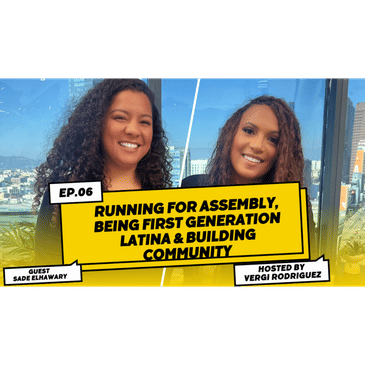
In this episode we had the pleasure of sitting down and talking with Sade Elhawary who is running for Assembly District 57 in South Los Angeles. She's been endorsed by current Mayor of the City of Los Angeles Karen Bass and is a champion for Black/Brown communities, a leader for social justice and people-powered coalitions. Sade tells us where her passion for community organizing started and how her Mom who emigrated from Guatemala has been her biggest inspiration and cheerleader.
[00:00:01] Welcome to A Race Of Your Own, I'm Vergi Rodriguez where we have discussions around how inspiration leads to resilience.
[00:00:08] And today's guest has a ton of points and things I need to cover but I'm loving it, I'm really excited and I hope I can get it all in.
[00:00:18] She has been a community organizer and educator who is running for the Assembly District 57 for South Los Angeles.
[00:00:24] She's been endorsed by local and state leaders, one of them currently being the City of Los Angeles Mayor Karen Bass.
[00:00:31] And she advocates for social justice, equity and opportunity for her district.
[00:00:37] She's a first generation born here in the United States.
[00:00:40] She is the first in her family to earn a college degree graduating from UCLA, my alma mater and Harvard.
[00:00:46] Yay, Bruins! Go Bruins!
[00:00:48] And after she went to college, she returned back to South Los Angeles to teach and motivate young people.
[00:00:53] She started working as a youth organizer at Community Coalition and starts and still works closely with them today.
[00:01:02] Welcome, Sade Elhwari.
[00:01:04] Thank you, I'm so glad to be here.
[00:01:06] Yay! I'm excited to have you. There's so much to cover and I mean just to start off, you are just your story, who you are, what you do,
[00:01:14] you really are one of those people that like walks that walk.
[00:01:17] Right? And a lot of what I talk about here is about purpose.
[00:01:21] And so I'm really excited to have you.
[00:01:24] And just, I don't even know where to start because there's so much and I want to cover all of it.
[00:01:30] But you know, wherever you'd like to start with either one of the points I touched upon or whatever.
[00:01:34] Yeah, you know, I'll just start with, I love that you said purpose.
[00:01:36] I think that recently I was talking to someone about, you know, what it means when we truly are and step into our purpose and how it feels so aligned with, you know, what we were meant to do here.
[00:01:49] And I'm really grateful because I always feel like I've been invested in my passions and I've been pulled in these different directions that allowed me to do work in my community, for my community, with my folks.
[00:02:02] And to now be running for office is, it wasn't in my kind of understanding of what I would do in my future.
[00:02:08] But now that it's happening, I'm like, oh, this is absolutely where I'm supposed to be.
[00:02:11] You know, and that feels incredible as someone who grew up not thinking that I could, you know, one day run for office.
[00:02:18] Right. We always talk about like we want little kids to know that they can become president.
[00:02:22] Right. And it just feels so exciting to understand and recognize that, you know, being able to be a woman of color with my background, a daughter of immigrants from L.A., born and raised here.
[00:02:35] And then to be able to now do this work and really represent my community in this way is dope.
[00:02:40] So I just feel grateful and I feel like that's what you're doing, like to really be in our purpose, I think, speaks volumes.
[00:02:45] And I'm excited about that. Yeah. And it feels good to see somebody, you know, so young, you know, not that I'm much older.
[00:02:52] We talked about this already before, but so young and so clear, like you're very clear.
[00:02:58] But but you also are doing the work. You're in your community.
[00:03:01] People know you in your community for the work that you do.
[00:03:04] Can you expand a little bit on Community Coalition and like the work that you've done there?
[00:03:08] Yeah, of course. So Community Coalition is an organization that's incredible.
[00:03:12] It's a nonprofit that was founded by now Mayor Karen Bass over 35 years ago now, almost 35 years ago.
[00:03:21] And it was founded because Mayor Bass at the time worked in an emergency room as a physician's assistant.
[00:03:27] And a lot of what was going on at that time during the crack cocaine epidemic was really impacting our community in all ways.
[00:03:34] And especially the black community, it was really ravaging our community.
[00:03:37] And a part of that looked like both in terms of violence, in terms of the addiction and really even for some of our young, you know, some of our parents who were becoming, you know, really addicted that were then passing that on to their children.
[00:03:53] Right. And for a lot of pregnant women.
[00:03:55] And then we saw with that man in terms of the foster care system, all these things.
[00:03:59] And Mayor Bass said, look, we can't just keep throwing away our community members and locking them up because they're addicted.
[00:04:05] This is a public health crisis. Now, years later, when people are addicted to opioids, we do something about it that's humane.
[00:04:12] But back then, the community coalition was really a group of folks from the community, black and brown folks who said we need to find an alternative response to this crisis, a response that is that humanizes our folks because it is a public health issue.
[00:04:28] And addiction is not something that people want. Right.
[00:04:31] And a big part of that came from all the deindustrialization of our community.
[00:04:36] Right. In South Central, all these amazing middle class families who could buy homes, who could live their lives in a place that was relatively safe.
[00:04:44] And and it shifted when there's not jobs anymore in our communities, because where folks were able to work was shipped out. Right.
[00:04:52] It was outsourced. And so folks so folks really came together and said, we need to do something differently.
[00:04:56] We need to think about what that means. And we want to create this community coalition to really organize our community members around how we can make a difference so that it's not just people.
[00:05:06] It's punitive. It's not just law enforcement. It's not just lock them up.
[00:05:09] And they made such a difference by doing that 35 years ago.
[00:05:12] And now the organization still thrives today by doing real organizing work, by getting the community itself involved in the process of what changes that we want to see in our communities.
[00:05:23] And then we developed their leadership. So I worked at high schools in South Central to really develop the leadership of the young people to say, OK, my school is it's it's falling apart.
[00:05:32] We need to change this. We need more resources. We need to change the funding. We need to change policies.
[00:05:37] Why are we getting suspended at higher rates than our peers?
[00:05:40] Because the policies allow for black and brown youth, especially young men, to get in trouble for something like chewing gum.
[00:05:46] And you could just kick me out of class and kick me out of school. No, we need to change that.
[00:05:49] And so the young people would go to the school board and they do the rallies and they talk. And it was just incredible.
[00:05:55] So that's the kind of work that I did at Community Coalition as an organizer and that what they do overall.
[00:06:00] Well, you know, and it sounds like totally what, you know, this show series is about, which is about inspiration through resilience.
[00:06:07] And that's from your own probably experiences, what you saw growing up.
[00:06:11] And then now you're bringing that back to your own community, which is amazing.
[00:06:14] I think that's amazing work. And I before anything and before we end, like I already see your future.
[00:06:20] Like I already know you're going to go places and you're going to do things.
[00:06:25] And it's really exciting to see, you know, especially in this political climate that we're in and just like how everybody feels about just politics and politicians at this moment in time.
[00:06:36] So to hear that there's someone, you know, actually doing that in their community and rallying up young, you know, young people to do it.
[00:06:44] How, you know, how do you kind of feel like the importance of that?
[00:06:47] You know, there's not we politician. I don't want to get too political, but, you know, they don't really talk about that.
[00:06:56] And you talked on brown and black. It's not just brown. It's not just black.
[00:07:00] It's both. It has to be because we have the same experiences, you know, and even though I didn't grow up in L.A., I grew up in New York.
[00:07:06] But from what you were just saying, we had some of the same issues back then. Right.
[00:07:10] So it's great to hear that, you know, there's this unity between both, you know, demographics.
[00:07:17] It's not just you're either. OK, the black community or just the Hispanic community.
[00:07:22] What about both? Right. Power in numbers. And, you know, I'll say I'll say two things.
[00:07:26] One is it's not all, you know, rainbows and butterflies. Of course not.
[00:07:31] There is work that has to be done to build that kind of solidarity.
[00:07:33] But the solidarity and the importance of it is something that at Community Coalition has been like the basis, the foundation, the values of really understanding that is is what Coco does.
[00:07:46] So Mayor Bass as a black woman who saw this ravaging the black community said, yes, like we could only organize the black community.
[00:07:54] But in reality, this impacts everybody who lives here. The Latinos who live in our community are impacted the same way our black folks are impacted.
[00:08:01] And so what are we going to do about that? How are we going to make sure that we are working together to make that happen?
[00:08:07] And so with young people, you've got to teach them young. You've got to have those conversations.
[00:08:11] And so when we do the leadership development, when we have we would have this leadership academy or we would go into it.
[00:08:17] We would talk about stereotypes and we would have the young people almost like, you know, go through the process of the like anger of like, how could you say that about my community?
[00:08:24] But also then say, well, what does that mean? And where does that come from? And why does white supremacy allow us to then and push us to fight each other so we can fight for crumbs?
[00:08:33] And the system continues to in and of itself kind of, you know, replicate the status quo, but we don't have and we don't have opportunity in the same way.
[00:08:42] And so a big part of that is hoping our folks understand we work together. That's how we that's how we are successful.
[00:08:48] That's how we make change. That's how we see the systems actually shift.
[00:08:53] And I'll say that running for office, a big part of it was because the city council a couple of years ago had these leaked recordings that were about.
[00:09:00] I remember. Yes. And that was horrific to hear that emboldened me.
[00:09:04] Like I was like, oh, you know, like, I've always been passionate. I've always been in the background.
[00:09:08] I've always done behind the scenes because that's who I am. But that day, oh, oh, like, like, we're not playing no games.
[00:09:14] I made these shirts. They said I'm with the blacks and I like maybe it went viral because because one of the things she said was F him.
[00:09:20] He's with the blacks talking about a Latino man who's the district attorney of this city.
[00:09:25] Like, how is that a problem?
[00:09:26] And supporting the black community. Wow.
[00:09:28] And this is a justice system that's clearly impacted our black community more than anybody are Latinos as well.
[00:09:34] But like for somebody to be then denigrated for that was crazy.
[00:09:37] So I went and I spoke and folks are like, hey, like, you should really think about what does this mean?
[00:09:42] You know, next steps. Like, have you considered running? And I'm like, that's not that's that's not in my understanding of my future.
[00:09:48] But we have to have representatives who understand why it's important to bring our folks together and not divide us because that doesn't help us.
[00:09:55] That doesn't help us get anywhere. I think that's just it's really powerful.
[00:09:59] It's just really powerful to hear that there's people like you out in the world that are doing what you're doing, you know, and to kind of piggyback off of that.
[00:10:10] You know, you were also one of your endorsements was from Dolores Huerta, who was an American labor leader and civil rights activist who with Cesar Chavez is the co-founder of the United Farm Workers Association.
[00:10:22] Yeah, that is amazing. And, you know, knowing how farmers are being impacted, you know, right now, I don't know how much of that you're also kind of taking into your platform.
[00:10:34] But like, talk to us a little bit about that and what that looks like. And, you know, hopefully for like the future of farming just in this country alone.
[00:10:40] Yeah, you know, I think the first thing I'll say is Dolores Huerta is an icon and I am so grateful for her support, for her love.
[00:10:50] And I think that, you know, my what I really appreciate about being a part of this entire process of running for office is that I get to learn so much.
[00:11:00] I get to learn from icons who she's now in her 90s and she's still vibrant. She's vibrant. Like she's out all the time. I was dancing with her at a party.
[00:11:10] But that's like you're like you're 90 and you're just not stopping. Yeah. And you don't care.
[00:11:15] And she's pushing for the right things and she's always about it. Right. And so I think the fact that she did the work to found the United Farm Farm Workers with Cesar Chavez.
[00:11:25] And then now there are so many important pieces around California is the fourth largest economy in the world.
[00:11:32] And a big part of that is our agriculture, a huge part. And so what does it mean for us to be one, protecting our farm workers themselves?
[00:11:39] Environmental policy is huge when we think about even the ways that we protect farm workers who, you know, we know we have an affordability crisis with housing that impacts all of us in California.
[00:11:49] Even folks who are now, you know, we think about the migrant farmers and the ways in which we have housing that we have to continue to build and ensure that we're providing. Right. We we are. I think really have to ensure that we understand that that's something that we have to do.
[00:12:07] That it's something that we are really, you know, when we have a country that's making money off of this, you know, this it's a big basis for our economy, then it's really incumbent upon us to make that happen.
[00:12:19] Right. And so, you know, the climate is changing and it's so bad for our folks.
[00:12:24] And some, you know, owners of the farmland don't even think that they have to provide certain protections to keep our folks out of the heat, to keep our folks protected and crazy weather.
[00:12:35] We were just here in L.A. in the last couple of weeks. Imagine how bad it was in the Central Valley. Right. Right. And so.
[00:12:41] And it's hot out there anyway, just any time of heat. Exactly. Exactly. And so just thinking about, you know, our food deserts, food insecurity, all of that, I think, is a huge part of what we have to understand and how we invest in.
[00:12:54] And and really making sure that we were doing everything we can for farm workers to continue to be to thrive if we want that to be a big part of our economy.
[00:13:04] Yeah, definitely. And I think that that's just again, it's just amazing work. I can tell that you're really doing it, you know, and tend to be next to someone like Dolores is is is amazing.
[00:13:16] And to hear that she's 90 and she's still she's out there walking that walk still is amazing to me.
[00:13:25] And so, you know, again, there was just like a few things that like I I wrote down and I was like, I want to cover all of it.
[00:13:34] And I don't even know where to start because it's so much.
[00:13:38] But, you know, you've you've worked with, you know, wellness centers for high schools where you created, you know, medical providers in areas where they were lacking medical providers.
[00:13:48] I think Fremont High School Wellness Center so that neighbors and students could access mental health, reproductive and primary care.
[00:13:54] Mental health is like a huge thing. I know people are like making it a big thing now.
[00:13:58] It's always been kind of a big thing. But but can you talk to us a little bit more about that as well, too?
[00:14:04] And kind of like will that program something like that expand? Do you see that expanding?
[00:14:08] So like how that ties into even if you become an assembly member? Absolutely. Absolutely.
[00:14:12] So I'll start by saying the wellness centers on school campuses is a huge deal because a lot of our folks, we don't have access in the same way in a place like South LA where there are not enough hospital beds.
[00:14:24] There are not enough, you know, access to to primary care physicians. We have to have these clinics.
[00:14:29] We have to have opportunities for folks to have someone that they can see more more readily for families, for undocumented immigrants and folks who aren't always, you know, feel comfortable with the system.
[00:14:41] Schools can be a safe haven. And so making sure that that's something that's not just for the students, but the students are important.
[00:14:47] Right. Thinking about birth control access. They actually have dental exam rooms there. They have opportunities, like you said, for counseling.
[00:14:53] Our folks don't always know how to access. And so when it's right there, it means that we provide an ease of access.
[00:14:58] We provide opportunity for folks to get seen so that we aren't lagging behind in our health because a lot of our communities are.
[00:15:05] We're really struggling with our health. So wellness centers are huge. They actually just had an article about it, I think, in the L.A. Times about the importance of and how much they're popping up.
[00:15:13] St. John's is a really good example of a clinic in South LA that's actually opened up clinics at various high school campuses.
[00:15:18] I have seen St. John's. I've been to a couple of them. They're amazing. St. John's is incredible.
[00:15:21] St. John's is incredible. And with the Wellness Center at Fremont, it was actually the UMA Community Clinic who created that.
[00:15:28] And they started as medical students, Muslim medical students out of UCLA who actually started that, I want to say maybe around 30 years ago, and decided to create from the work that they were doing on the campus.
[00:15:40] They took that and created these clinics around South Central LA, and one of which is now at a school, which is huge.
[00:15:47] So I started there to say yes, yes, and yes. Absolutely. As an assembly member, I hope to be able to invest more.
[00:15:54] Health is huge to me, but in particular mental health. And so, you know, I didn't mention this earlier, but I'm a foster mom.
[00:16:00] My baby girl is 22 now, but I met her as a teenager and she really struggled with mental health, especially, you know, I met her and I was her mentor first.
[00:16:09] But being removed from your home at a young age, at any age is really tough. And so seeing how the schools were able to support her was really important.
[00:16:19] The organization, she was part of COCO, Community Coalition, we call it COCO. She was part of their after school program.
[00:16:24] And so they had opportunities to connect her to services as well through wellness, which is an example of a mental health provider in South LA.
[00:16:31] And for me, it's mental health specific, not just to young people who struggle, but we know that our young people are struggling.
[00:16:40] We know suicide rates are high, incredibly high, especially amongst our younger generations, but also our unhoused folks who are on the streets, who are struggling with mental illness and don't have the supports and services they need.
[00:16:50] If we're going to get them housed, we need to get them services. If we're going to create housing, we need to make sure there's wraparound services there that really focus on mental illness.
[00:16:59] There are really things. Like, I have shown some of my bending lessons in my life.
[00:16:59] There is also substance abuse prevention. A lot of folks who are addicted, how do we provide not just prevention, but the treatment itself.
[00:17:06] Because so many of our folks actually turn to cope through a little bit of this, a little bit of that.
[00:17:12] And that's how the addiction starts.
[00:17:14] My cousin just passed away from a fentanyl overdose.
[00:17:17] And I know that a big part of it was that he would just do something on the weekends or every whenever to try to deal with how he felt, and didn't know how to really express that
[00:17:27] for a lot of our men of color it's it's considered weak to get help and so we
[00:17:32] have to shift the narrative around mental health and supports while also
[00:17:36] recognizing the actual treatment the services the access how do we make it
[00:17:40] easier for folks how do we make it something that is part of your health
[00:17:43] insurance and not something that you have to go in loops or and jump through
[00:17:47] hoops so that you can figure it out you know what I mean so I think all of that
[00:17:50] is hugely important to me and post pandemic so many of us have been
[00:17:54] impacted post pandemic so many and it's funny I was just having a conversation
[00:17:58] about this it's like it's like oh that was pre-covid oh you mean after COVID and
[00:18:03] it's like you see a difference and how people but some of the things that you
[00:18:06] touched upon a couple of things immigration being one especially the
[00:18:09] state of how California is in in that right kind of way but also you know the
[00:18:16] homelessness homelessness has been an issue I live not too far from here and it
[00:18:22] is it it it got has gotten bad you know and so what are you know how do you see
[00:18:28] that being fleshed out and I know that as an assembly member that's you know might
[00:18:32] not be fully your scope right but it's a part of it it's a part of it right but
[00:18:37] it's you know it's kind of like it's a bigger issue because we're talking about a
[00:18:42] state right this is statewide there's people up north that are also dealing with
[00:18:45] the same thing and so how do how do how do we address that how do we attack that I
[00:18:50] know we're all paying our taxes we're all doing our thing so how do how do we
[00:18:53] really start to really see change because again being from the East Coast
[00:18:56] yes you see homeless people and yes there's an issue there now even with
[00:19:00] immigration and what that looks like but specifically to him to homelessness you
[00:19:05] know there was a there was a you know places that people could go and sleep you
[00:19:10] know every other block you know here it's it wasn't as much and I don't know you
[00:19:17] know what can we get on the docket what can we do to really be like look you know
[00:19:22] that these people not only need a place to live but like you said the mental
[00:19:26] health is huge because most of them are addicts you know I've had friends and
[00:19:30] family that are addicts and have had seen them you know do 12 steps but it's
[00:19:34] because they had the access they knew that they they could right they had that
[00:19:38] support they had the community support yeah so you know where do where do we see
[00:19:43] that what can we do right like what could I do today to be like we need more
[00:19:47] shelters yeah I think so I'll start by saying yes to everything you said and
[00:19:53] that's loaded yes to everything you said at the state level it's actually a huge
[00:19:59] piece because a part of building more houses building more housing is that we
[00:20:04] have to one change certain legislation that uh that is a barriers that are that
[00:20:10] provide barriers that really make it hard to build right for different reasons
[00:20:15] and make there are certain areas even in Los Angeles right now they just did a
[00:20:18] zoning study and most of Los Angeles is actually I want to say about 70% is
[00:20:23] zoned for single-family housing and people don't want to see their communities
[00:20:31] shift and so oftentimes you hear this like nimby like not in my backyard like yeah
[00:20:38] please house the homeless we don't want them here though like don't build the
[00:20:42] don't build the homeless housing in my backyard build it over there like build it
[00:20:45] and so what you end up doing is concentrating poverty in specific areas
[00:20:50] where people aren't fighting against the housing because they know the
[00:20:52] importance because we know in a place like South LA we recognize how
[00:20:57] unaffordable it is so we want there to be more housing built because then that
[00:21:00] means we can get into that housing that means more of our folks who are on the
[00:21:03] street who probably came from South LA a majority a vast majority of folks who are
[00:21:08] on the streets are coming from our communities because it's no longer
[00:21:11] affordable they're getting gentrified out it's hard to stay in LA period and and
[00:21:16] the the fastest growing population on the streets in addition to seniors are
[00:21:19] our single family single excuse me single mothers Latinas head of
[00:21:25] households who literally just cannot no longer afford to live and pay rent in this
[00:21:31] community and so they're living on the streets with their kids and we're
[00:21:35] allowing that if we don't build more housing and so the zoning study oh it's
[00:21:40] about to go down because people are like wait wait wait we don't want to see
[00:21:45] more housing built in areas we don't want to change these zoning laws we love the
[00:21:48] way our community is it's a tight-knit community and people love each other
[00:21:51] we don't want it to go too high or too and and all of that is real but we're in a
[00:21:55] crisis and when you're in a crisis you have to do everything you can to
[00:21:58] address that crisis right and so the goal is to build I think it's like some
[00:22:03] crazy number like millions of homes millions of new housing in that's the
[00:22:08] state of California and I think 250,000 needs to be built in LA which is why they
[00:22:13] did the zoning study because they say well if we're gonna build 250 if the
[00:22:15] directive is we have to build this where are we gonna build it right let's figure
[00:22:18] out what the zoning is and how we can shift this but people are fighting and
[00:22:22] they will continue to fight and they they will say well if you don't vote for what
[00:22:25] we want we'll vote you out right and so then it becomes okay do I stand up for
[00:22:29] what's right and build housing in communities like what the west side or
[00:22:33] do I stand up for what my community is saying that they want and eventually
[00:22:36] potentially not be in the seat and so it's beautiful to see there are council
[00:22:40] members there are folks here in LA who are like look I'm sorry like if we allow
[00:22:44] community members to tell us when and where to build we will never build in more
[00:22:48] affluent communities right and that means we won't ever have enough housing for our
[00:22:52] folks but when it's a crisis we got to do what it takes to address that and so I
[00:22:56] think it does take folks at the state level it takes money from the state level
[00:23:00] you can't have directives without the resources behind it that's why we got it
[00:23:03] we like keep getting money from the federal level but we got to make sure
[00:23:06] that we're holding cities accountable because I'm talking about LA City cuz
[00:23:10] that's where I'm running right but there's all these small cities around here
[00:23:12] that are like well actually can you just build it over there can you just build it
[00:23:16] over here we don't want the you could build here but it should be more like
[00:23:19] luxury right and then you have all these places like in downtown LA that are
[00:23:24] literally empty empty vacant so many like the vacancy rate is so high and
[00:23:29] that's office buildings too so we have to even think about rezoning and and
[00:23:34] reusing rights it's called adaptive reuse for some of these office buildings
[00:23:37] that were specifically supposed to be used for work right for offices they need to
[00:23:43] become homes because we recognize that we're not coming to work anymore most
[00:23:46] folks are working from home remotely and they're not gonna come down to downtown
[00:23:51] so these office buildings then we need to really think about how we utilize that for
[00:23:54] housing too so there's all these different I think bold solutions that we
[00:23:57] have to think about there aren't enough shelters there are shelters they are but
[00:24:02] they're just aren't enough for what we have and so we got to keep building keep
[00:24:05] building and we don't just want to build temporary shelters we need to build
[00:24:08] permanent housing solutions for our folks especially because we know that it's not
[00:24:12] no longer affordable in LA right right and and you know and that's it's good to hear
[00:24:18] that like there you guys are talking about it right like it's it's there people are aware of what needs to happen because yeah sure
[00:24:27] there there might be some neighbors are like I don't want you know a shelter
[00:24:30] close by but allowed is literally smack dab in the middle of LA what do you I mean
[00:24:35] what do you expect right so would you rather them just be on the street right
[00:24:39] you know and then just have no resources at all and you know left to their own
[00:24:44] devices and you know LAPD you know comes up rolls through at 3 in the morning
[00:24:49] because somebody's being whatever in the middle of the street you know or have
[00:24:53] them placed house somewhere right that they could possibly get a place to live have
[00:24:59] a roof over their head but also resources I think resources you know and there's
[00:25:04] there's a whole other discussion around that around you know not wanting curfews
[00:25:07] and yes there there's a whole other thing there and that's a whole other yeah
[00:25:11] ball of wax but I think the fact that you guys are talking about it seriously
[00:25:16] there's other people talking about it it was just great there was another point
[00:25:20] that I saw about your mom she organized a young Latinas for for the she
[00:25:26] organized a group of young Latinas for the annual college and career
[00:25:30] conference which was called Adelante Mujer Latina and through the
[00:25:33] Latina program at woman at work she helped connect thousands of women every
[00:25:37] year to good paying jobs it's from it says it's from your mom that you learn
[00:25:42] this kind of persistence and importance of being in service so talk to us about
[00:25:46] your mom I mean you know I know this will be kind of probably right at the tail end
[00:25:51] of Hispanic Heritage Month and you know I know your mom is Guatamanteca and tell us
[00:25:57] about that because it sounds like she kind of rubbed off on you in that sense a little bit
[00:26:01] so I'll start by saying my grandmother my mother's mother just passed away today and
[00:26:08] my mom so I'm my mom it's really like heartbroken so I was just checking in on
[00:26:14] her but part of why I brought that up is because my mom is currently working on the campaign she's a
[00:26:20] canvasser nice she knocks on doors every single day in South Central to tell people to vote for our
[00:26:26] campaign and her daughter yeah of course and first of all my mom is so funny because she said Mika I
[00:26:33] will help you but you have to paint me like I'm not about to just show up I was like listen I have a
[00:26:38] busy schedule I have bills to pay I have things to do and so she does it she knocks on doors every
[00:26:44] single day and yesterday someone actually showed up at our headquarters she said I have to meet the
[00:26:50] daughter of the woman who showed up to my door because that woman convinced me that you are the
[00:26:56] right person for our community but I want to know who did she raise I want to see what she looks like
[00:27:00] that's what she said well I knew my mom like I know she's out there like really putting in work because she
[00:27:06] believes in me but I really do take after her when I was a young person I remember so vividly in
[00:27:13] elementary school my dad was around much more as a kid and my mom she was involved in everything like
[00:27:20] she was involved she was on the Planned Parenthood advisory board she was on like the head start
[00:27:25] like some type of parent like liaison she was Latino mom think because my mom was the same way she was
[00:27:31] like she whatever she could and so I didn't see her a lot as a kid I feel like she was always doing
[00:27:38] stuff there's more to that right like I feel like there was a lot of abuse at home so I think my
[00:27:42] mom was like the more I don't have to be at home the better but I think for her it was this like
[00:27:47] passion that she had to support the community she learned she came from Guatemala without a lot and
[00:27:53] recognized that you know she was gonna have to figure it out she was gonna have to to do something
[00:27:58] to to figure out her own life and then had three daughters and she was like now she wants to make sure
[00:28:02] she does the best she can for us so sometimes she especially my parents weren't together she would
[00:28:07] have to take us with her to these gala dinners where she was going to fundraise for this conference
[00:28:13] and she'd take us and she'd she'd leave us at the table and I'd be like mommy I hate wearing these
[00:28:18] dresses and I hate coming to these things and I get so tired and I try to fall asleep she'd be like
[00:28:21] wake up mija we're eating you know like we're like oh so you know but she she totally like was exposing
[00:28:29] us to something that I didn't understand at the time right I didn't understand what it meant to really be
[00:28:34] able to fundraise for the vision that we believe in for our community so she'd you know shake hands
[00:28:39] with someone from let's say US Bank who was the the liaison for government affairs whatever the
[00:28:44] community liaison and she'd be like I'm having this conference um can you give to the conference so we
[00:28:50] can help put it on and I remember her being like oh I got fifty thousand dollars and I got fifty thousand
[00:28:55] dollars for a conference like how do you do that kind of stuff and that's because she knew that she
[00:29:00] was gonna be able to come back bring it back to the community she she served folks LA County the
[00:29:05] Inland Empire like I want to say Antelope Valley came through and they all came to this conference
[00:29:10] young Latinas who knew especially at the time because our birth rates were incredibly high
[00:29:15] um our high school dropout rate was incredibly high and so there was this understanding that we need
[00:29:23] to invest in our young Latinas and for her that meant I'm gonna do this conference every year
[00:29:28] in addition to what she did all the time that was her her job was career counseling for Latinas
[00:29:33] especially recent immigrants but in understanding too well what about our young Latinas who are now
[00:29:38] here who are the daughters of those immigrants too oftentimes and so so much of what my mom did as a
[00:29:43] young person I've learned from and she always laughs because she's like me I wanted you to be rich
[00:29:48] I wanted you to go and get you know I mean like I wanted you to be able to to make money and not
[00:29:53] be you know doing this community work but I'm like mommy I learned it from you and my sisters
[00:29:58] to my my youngest sister is a high school counselor at her at the school that she went to for high
[00:30:04] school my middle sister she just had two babies but before that she was working on in the public
[00:30:10] defender yes I love my babies she was in the public defender's office helping folks who were charged
[00:30:16] making sure they had the resources because sometimes when you as soon as you get charged I mean it makes
[00:30:21] it tough for you to do anything right and so just really grateful that my mom really laid the foundation
[00:30:27] for us as someone who just understood the importance of giving back it sounds like it and you know
[00:30:33] there's some parallels here that I feel like exist between us because my mom I don't know if that's a
[00:30:38] Latina mom thing I don't know I don't know but you know my mom being Dominican coming to this country I'm
[00:30:43] also first generation and her she worked as a social worker for the city of New York so you know young Latinas coming through her office
[00:30:51] was a thing and she always she always saw you know I remember one time she came home crying because she
[00:30:58] was like there was this 15 year old you know young Latina you know she was in the Bronx and she was like
[00:31:04] you know she came in pregnant and her mother had kicked her out and she just started she couldn't because
[00:31:10] she saw my face in her face and she's like don't you ever come home pregnant too young you're too young
[00:31:15] you know but she you know it touched her in the way she's like that could have been that could be my
[00:31:21] daughter right but could I ever kick her out like that you know I don't think I could ever do that but
[00:31:25] it would break her heart every day and so you know so it was something always about giving back she was
[00:31:31] always you know involved in like politics and like unions and you know working with politicians local
[00:31:37] politicians and so you know I think it's you know it's kind of like I feel like because kind of what
[00:31:44] you're talking about your mom and what I've experienced even my mom growing up it's like they have this um you
[00:31:49] know this love for this country right they have this this like there's this opportunity right there's
[00:31:55] hope yes right to better the world in some way even if it's just locally in your own neighborhoods and
[00:32:02] with your own community there's something about community there and there's something about like
[00:32:08] hope actually instilling hope and actually being able to do something about it right because they
[00:32:15] definitely want to give us a better life that yes you know that's why they came here you know my mom
[00:32:18] says the same thing I just want you to be rich like but yeah I'm like mom but I just it's about
[00:32:22] purpose for me I want I want to get these conversations out I want to do these things and so you know something
[00:32:28] I also kind of talk about here just to kind of wrap start to wrap our conversation up there's so much that
[00:32:33] we talked talked about how do you feel you know what's something for you that you feel makes you or what
[00:32:41] you've learned in your life up until now that is important to be in a race of your own right I always
[00:32:48] talk about being in your own race in your own lane and sometimes we go through valleys we go through
[00:32:53] hills sometimes we plateau sometimes there's tumbleweeds right but what what to you kind of keeps you in
[00:33:00] that race of your own to keep you kind of focused and going yeah I think oh that's such a good question
[00:33:07] I feel like I'll start by saying I was the eldest of three girls and I think being a big sister was really
[00:33:16] important to me and protecting my sisters because I mentioned earlier there was a lot of abuse at home and
[00:33:22] I a lot of emotional and verbal abuse and I think recognizing as as someone who just always wanted to
[00:33:31] protect and really support the folks around me I think that's something that has stayed with me and I
[00:33:38] think in terms of just the ways I I recognize that we were then invested in right like I remember going
[00:33:46] to school as a young person and one of my teachers come on I told you my mom was always busy sometimes
[00:33:52] she wouldn't come pick us up on time and sometimes they'd have to you know they have to take you to
[00:33:55] the police station if your parents don't come on so oh because because if your parents aren't there
[00:33:59] they gotta go home like there but eventually I think she started to say you know like maybe I'll just
[00:34:05] take you with me to my house and your parents can pick you up from there because clearly they're
[00:34:10] like being neglectful but also they love you and they're not doing it on purpose and so let me see
[00:34:16] what I can do to support and and she created a good enough relationship with my parents that she started
[00:34:20] to I think recognize that we needed this support and I feel like there's something so important about
[00:34:27] when you see somebody investing in you and what it means for you to then invest back into others right and
[00:34:33] paying it forward and I think that's the the I think the race of my own like I had so much support in
[00:34:40] school that I was able to go to Harvard like that's amazing I would never even touch well I mean I said
[00:34:45] it yeah like I would never have imagined that as a young person I would never have imagined that to be
[00:34:50] able to go to Harvard I knew I was always a smart kid don't get it twisted like I was that kid yeah but
[00:34:54] never enough like like it felt so out of reach it did and even when I went to UCLA my mom was like me how
[00:34:59] did I do that but you should have you should have applied to Harvard I'm like girl I don't even have
[00:35:03] those kind of Harvard grades but for me the reason I even got to UCLA was because I was a well-rounded
[00:35:09] student my my grades weren't the best but I always gave back I always got involved in something I was
[00:35:14] part of the other Latin Latin teen advisory board I was part of all these cool things that for me was
[00:35:20] was so cool but it was really about giving back it was really about doing something for my community
[00:35:23] when I got to UCLA I did the same thing I went back to my old high school I helped students apply because I was
[00:35:29] part of the class of 96 black freshmen at UCLA out of a class of 4,500 less than 100 because of the impact of
[00:35:36] affirmative action so I said well I want to do something I don't want it to look like this forever
[00:35:40] did that I was able to get involved and I was in a Latina sorority and our philanthropy that we did was
[00:35:46] going into the high schools and mentoring young Latinas a part of what I did I was a student activist so
[00:35:52] we were fighting for more funding right and all of that made me who I was so when I applied to Harvard my grades were good
[00:35:57] but I got a full ride to go to Harvard that's amazing because of the work that I had done because I can't right and so
[00:36:03] I think to be in a race of my own like I really do believe that we are put here for you know for a
[00:36:09] purpose and I think the fact that I was able to come back home and be introduced to Community Coalition it
[00:36:15] was so random I had this summer job and my best friend I was like girl I don't got a job can you help me I
[00:36:19] know it's Harvard but I don't know I'm not ready for what's next and I found this this opportunity that
[00:36:24] literally opened an entire new world for me to start at Community Coalition then move to the East Coast
[00:36:29] and start a brand new school be a part of the Department of Education there and then to come
[00:36:33] back I feel like it is so important that you know even as we we experience these peaks and value valleys
[00:36:40] as we recognize that things are hard that we ultimately are here for a purpose and when we listen
[00:36:47] and we take the time when we take the opportunity to really like going go within that we are here for a
[00:36:53] reason and that we do have a race that we need to keep pushing toward and so when people say how's
[00:36:59] your race going how's everything going on the campaign I always say I'm pushing hard we're
[00:37:03] making it happen but we need your support because we can't do without the support of everybody else I
[00:37:08] am NOT running by myself and I'm not running for myself I'm running for our community I'm running
[00:37:13] with our community and our community shows up we had over a hundred folks knocking on doors with me a
[00:37:18] couple weeks ago that's amazing right and and I'll say like the last thing a really good example of what I'm
[00:37:23] saying so we have amazing folks who are on our campaign our volunteers are so though and one
[00:37:33] example in particular is we had one of my mentees so I talked about being an organizer also trained
[00:37:39] organizers that was what I did when I came back to the organization and he had spent 17 years in prison
[00:37:44] and now he works for the mayor's office Wow incredible young man a little older but you know in the sense of
[00:37:51] like he's just great yeah yes and he brought he said look Sade I work for the mayor and she's working
[00:37:56] me hard I can't help you but I'm gonna bring somebody and he's gonna help you but look I'm
[00:38:02] gonna introduce you to him he spent 24 years in prison he just got out two weeks ago and he wants
[00:38:07] to help he's ready to help he was doing the work behind bars and he's ready now but he's never done
[00:38:12] this so I want you to really take him under your wing I took him with me we knocked on some doors it was
[00:38:16] amazing like he was in it with me he was like sharing his story you know being the son of a single mom and
[00:38:22] how he ended up on the wrong path and why we need representatives that really support folks right and
[00:38:27] then he was like loved it so much he went back to his transitional home and he told his homie Adonai
[00:38:32] he was like yo you should go go get involved in this campaign you'll like it you'll really it'll be dope he
[00:38:38] comes he spent 30 years in prison and he had been out for three weeks and he he actually had just come from
[00:38:46] a little late so they brought him directly to me while I was knocking on doors and I was like nice
[00:38:50] to meet you we're knocking on these doors I don't have time to train you but you gonna learn along
[00:38:53] the way and he was in it and he loved it so much he has not left our campaign he is doing everything
[00:39:00] he supports me with fundraising he helps us do research he's knocked on doors he's done outreach
[00:39:06] he's outreach to other guys he went and brought 10 more guys who are former lifers because he knows
[00:39:10] that it's legislation that allowed him to get out of prison he thought he was gonna be there forever
[00:39:15] he was 16 years old when he went to prison and he never thought he would get out and the only reason
[00:39:23] he got out is because of folks in the state legislature who said how are we putting 16 year
[00:39:28] olds away forever for life they need to have their cases reviewed because that 16 your brain is not
[00:39:33] fully developed and you deserve to have an opportunity you're a baby to see if you've been rehabilitated
[00:39:38] and your time in prison you should have an opportunity to get out yeah and that's why and he's like
[00:39:43] Sade you get to be a champion for me if you win and so I want to make sure you win yeah definitely
[00:39:49] that's that's amazing and that's that's really like I think it's what you're bringing to the table right
[00:39:56] it's what what you're bringing to the race so to speak so that people are jumping on your race
[00:40:01] literally like kind of literally and kind of hypothetically here but like are actually jumping
[00:40:06] onto your race because of the energy you're exuding because you're really you're really saying these
[00:40:11] words but you really mean it because you live it yeah and you've been living it for a long time so
[00:40:15] I just really appreciate having you here I I'm I I think you're gonna win but that's just me
[00:40:22] we gonna win we gotta claim it this is my purpose that means that means you know yeah here so I I you
[00:40:29] know I think you're gonna do great and even if you don't I still I still see a really bright future
[00:40:34] for you you know for this city hopefully for this state and bigger thank you so congratulations on
[00:40:40] everything and congratulations on everything that you've done and so this is another episode of a race
[00:40:46] race in your own I'm Virgie Rodriguez don't forget to subscribe