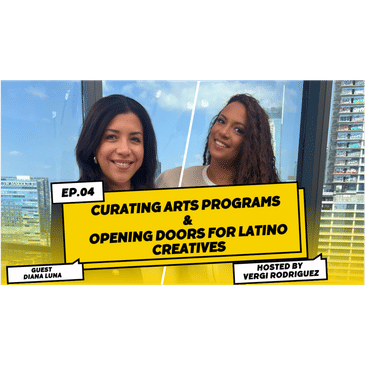
This week's guest is Executive Director of the National Association of Independent Latino Producers. Over the course of a 20 years of career, Diana Luna has prioritized creating opportunities that support the professional advancement of individuals in a variety of creative fields, in particular those from underrepresented communities. With an extensive background in curating Arts programs she has been a champion for Latine creatives.
Diana Luna https://www.instagram.com/lunadiana29/
NALIP https://www.nalip.org/ https://www.instagram.com/nalip_org/ / nalip
Race Of Your Own
https://www.instagram.com/raceofyourown/
https://www.instagram.com/vergiluv/
Produced by : Planet V Productions
Please remember to subscribe.
[00:00:00] Hi, I'm Vergi Rodriguez and welcome again to A Race Of Your Own where we discuss, you know, we have discussions about inspiration that lead to resilience.
[00:00:09] And today's guest, you might just know her just from her title alone, Executive Director of the National Association of Latino Independent Producers, also known as NALIP.
[00:00:20] She's been a leader in the entertainment and education sectors, over 25 years of experience promoting the professional development of Latinos in the United States.
[00:00:29] And I mean, her, you know, accolades are endless.
[00:00:35] She's been focusing on establishing strategic alliances within creative industries to facilitate access, visibility and professional advancement at all levels.
[00:00:44] So this week's guest is Miss Diana Luna. Welcome.
[00:00:47] Thank you, Vergi. Very happy to be here.
[00:00:49] Yes, I'm excited to have you. Thank you for taking the time, especially during Hispanic Heritage Month.
[00:00:55] That is probably one of your busiest times of the year.
[00:00:59] Amongst other times of the year. So thank you.
[00:01:02] You're welcome. Happy to be here.
[00:01:03] Yeah. So, you know, tell a little people, tell our viewers a little bit about your background.
[00:01:10] How did you want to get, you know, started in entertainment?
[00:01:13] How did you happen to kind of make that connection with NALIP?
[00:01:18] It is a very interesting journey when I look at it because I've been working for so many years with everything that has to do with arts and culture, mainly focused into higher education.
[00:01:34] Many years ago, I was running a master's degree in arts management and also developing an art business program.
[00:01:45] And among all my and all my life, I've been very passionate about the arts because my dad was an artist himself.
[00:01:51] So I've always been very close to that world.
[00:01:55] So it's always been my passion.
[00:01:57] And it was just kind of very fortunate consequences that I ended up in higher education working for all the arts nonprofit sector,
[00:02:05] where I had incredible mentors and through their passion for understanding how important it was to Latinos to be represented.
[00:02:17] And in that particular moment, it was mainly arts and culture.
[00:02:20] If you think about it, we have weights in many other different areas.
[00:02:26] But this one to me was very important to understanding why Latinos were not as represented in the performing arts, the visual arts, in dance.
[00:02:37] So that's how these master's degrees got developed so that it could help leaders of nonprofits to really promote their their work.
[00:02:48] So that's pretty much how it all got started.
[00:02:51] And then later, I got invited through Hola Mexico Film Festival to develop a program for emerging filmmakers.
[00:02:59] And I saw immediately the connection because it is pretty much the same challenges, but also the same opportunities.
[00:03:07] So I started I told actually the director of the festival, I said, OK, I have no time because I'm working.
[00:03:14] But if it's going to take me no more than three months developing the program and implementing, I can do that.
[00:03:20] But just this one time only.
[00:03:22] And then eight years later, they stuck you in.
[00:03:27] You were like, yep, I'm here now.
[00:03:28] OK.
[00:03:29] Eight years later, I was like, this is the very last time.
[00:03:31] Eight years later, I'm still saying this is the very last time that I'm supporting this program that is called Tomorrow's Filmmakers Today,
[00:03:38] which today is a network of about 160 filmmakers from emerging and now all in incredible careers.
[00:03:47] And it was just a way to connect them, to create a strong network, to provide the resources to enter the industry.
[00:03:54] And now it's an incredible network of professionals helping each other out.
[00:03:58] And eight years ago is when I found out about Nalip.
[00:04:05] As I was developing this program, I really want to be embedded with all those resources for Latinos.
[00:04:10] And Nalip back then was one of those few organizations focusing on the Latino entertainment industry.
[00:04:18] So I remember going once to one of their summits.
[00:04:24] And back then, the executive director was Axel Caballero, and now he's at Nalip.
[00:04:31] And it was very funny because over the Latino Film Institute.
[00:04:35] Yeah.
[00:04:36] And I saw the work that he was doing there and the community and how vibrant he was and how relevant it seemed to be.
[00:04:45] So I thought, one day I'm going to have his job.
[00:04:48] This is it.
[00:04:50] That will be my job.
[00:04:51] And then a year and a half ago, they reached out to me.
[00:04:57] And when I saw it, I thought, well, this is meant to be because I called it out eight years ago.
[00:05:03] Yeah.
[00:05:04] You manifested it.
[00:05:05] Yeah.
[00:05:05] Yes.
[00:05:05] And I think it was so strong.
[00:05:07] And I've always been so passionate about the work of creatives.
[00:05:10] I am very always energized and motivated to work with the creative mind because I am a strong believer that the creatives are those that change the world.
[00:05:22] And without people being creative, we wouldn't have a voice as humans.
[00:05:27] And it's always, you know, it makes me feel very humble every time I'm supporting a producer, a director, a writer, because they are the ones speaking for us.
[00:05:39] And yes, you can have the news, et cetera.
[00:05:42] But the feelings and the way that you see the world, it can only be expressed by those that are using those tools from dance, paint.
[00:05:50] And in this particular film or any other thing that has to do with the creativity.
[00:05:57] So that's how Nalip came to be.
[00:06:01] Yeah.
[00:06:02] And your involvement in it.
[00:06:03] And it sounds it's very much like I talk a lot about like purpose and finding purpose and kind of the way in life you are in a race of your own.
[00:06:13] Right.
[00:06:13] Like you're on your you know, you're with Hola Mexico.
[00:06:16] You're working with them and then Nalip, you know, this opportunity pops up and you knew about them.
[00:06:22] You had heard about them.
[00:06:23] But, you know, the connection didn't happen.
[00:06:26] And then you're like, wow, but I love the community of it.
[00:06:28] Right.
[00:06:29] And how important community is in telling our stories.
[00:06:33] And, you know, I was talking to you earlier about my short film.
[00:06:36] That was that was the main one of the main reasons I did it.
[00:06:39] I wanted to start a conversation, but I also just wanted to say a perspective from one side.
[00:06:45] Right.
[00:06:45] And so growing up with like a father who was a painter, he was a sculptor, sculptor.
[00:06:51] And that was where was that?
[00:06:53] In Mexico.
[00:06:54] Wow.
[00:06:54] And then was it how do you feel like that really kind of, you know, as an expression, right, a form of expression for yourself?
[00:07:03] Did you ever get into any type of arts, too?
[00:07:06] Interesting enough, growing up, every weekend, my dad will take me and my mom, mainly my mom.
[00:07:14] And then I was there, I guess, to an art show or performance or to a museum because, again, he was so passionate about it.
[00:07:24] So every weekend, mainly on Sundays, he was a Sunday thing that he will find something so that we could be exposed.
[00:07:32] Because, again, he's the one that taught me that it is through arts that things change where you become a better human when you are exposed, when you're able to admire, when you take the time to sit and watch, to listen.
[00:07:47] And my dad liked to take me, actually, because my mom will fall asleep and she will get very bored.
[00:07:52] Okay.
[00:07:53] You're like, I'm paying attention.
[00:07:55] Exactly.
[00:07:55] Just to prove the opposite.
[00:07:57] Then I was there, sitting and paying attention and trying to learn as much as I could because we had fun.
[00:08:02] It was very simple.
[00:08:04] And I never really understood how important that was until, again, these jobs came to me that I thought, oh, wow.
[00:08:12] I mean, this was like a lifelong learning experience.
[00:08:17] And today, I've been able to professionalize what I've been surrounded all my life that is an artist.
[00:08:25] Yeah.
[00:08:25] Yeah.
[00:08:26] And it's interesting to me.
[00:08:27] I keep kind of like seeing you, like this little girl going, seeing these sculptures or these paintings.
[00:08:32] But you went from like a still painting or like a still picture to a moving picture.
[00:08:38] And so there's this kind of connection, right?
[00:08:41] Like when it comes to like you were watching still pictures to a movement.
[00:08:45] It is absolutely similar.
[00:08:48] The only difference within these two art forms is movement.
[00:08:52] Yeah.
[00:08:52] Even technology nowadays.
[00:08:54] I mean, they are going head to head.
[00:08:58] AI is scary.
[00:08:59] It is mainly, yeah.
[00:09:00] But I think it's mainly how humans are able to express and the need for expression and the aesthetics of it.
[00:09:09] So aesthetics is, I think it's a very interesting concept that it changes from experience to experience or from setting to setting.
[00:09:17] But at the end, it is what the humans are able to comprehend.
[00:09:23] I mean, we're the only ones, right?
[00:09:25] Animals can't.
[00:09:26] And sometimes actually, I think they do, you know, like spiders.
[00:09:29] In their own way, right?
[00:09:30] In their own way.
[00:09:31] But it's such an important concept.
[00:09:33] Yeah.
[00:09:34] And the importance of Nalip in all of that, because I've been to so many Nalip events.
[00:09:40] I've really, you know, the way you really support the community.
[00:09:43] I mean, you're here.
[00:09:44] So like you really, you know, you walk the walk, you talk the talk and you're really about it.
[00:09:49] And, you know, for anybody that kind of doesn't know about the other things that Nalip does in kind of creating opportunities for those voices, could you expand on that?
[00:09:59] Yeah.
[00:10:00] Also, when I found out about Nalip, I was also fascinated by the work that they have done throughout the years.
[00:10:07] This is an organization with 25 years of history behind.
[00:10:11] And it all started back in the day when we talk about the Selena movie, for example.
[00:10:17] One of my favorites.
[00:10:18] My Familia.
[00:10:19] And, you know, I mean, with Eddie Olmos, with Moctezuma Sparsa, Jerry Nava.
[00:10:24] Like these incredible figures understood at that moment in time the importance of the Latino representation.
[00:10:33] And throughout the years, you know, the entertainment has changed.
[00:10:38] And the Latino representation has had its peak and then the very lows.
[00:10:43] And this is how this organization became very important to advocate for something that should be very obvious.
[00:10:50] And that is basically inclusion.
[00:10:53] I mean, I find it so at times absurd, right, that we have to have organizations like this when we're talking about talent, we're talking about excellence amongst our creatives.
[00:11:06] So Nalip was founded within that premise to support independent producers.
[00:11:16] And also the reach for Nalip, understanding that it's not only the producers, but directors, writers, and beyond.
[00:11:28] And basically people in front and behind the camera.
[00:11:32] So today, Nalip continues advocating, of course, for the independent producers that I think are going to become the thing.
[00:11:40] It's the next big thing.
[00:11:42] I'm pretty sure about that.
[00:11:43] But also supporting through providing resources, connections, giving them visibility, providing incubator programs, and any other tool that will support your career, advance your career.
[00:11:59] And that's what we are waking up every morning, understanding into what are the needs of our members, but also what is the current state of the industry.
[00:12:11] And understanding what is our place there and how can we push and move forward into amplifying not only the Latino content, but people in the decision-making rooms.
[00:12:24] Understanding who are those decision-makers and how can we change the narrative of these very few Latinos in media.
[00:12:34] So we're working.
[00:12:35] We have a big challenge.
[00:12:37] Yeah.
[00:12:37] Still.
[00:12:38] And it is important to have organizations like this because it is, you know, growing up, you know, I, one of the first faces I saw, like a big screen was, you know, in West Side Story, right?
[00:12:49] Rita Moreno, you know, playing Anita.
[00:12:51] And, you know, we didn't see that a lot.
[00:12:53] That was the closest I felt like there was a character on screen that looks like me.
[00:12:58] And so having this space of where you're creating a space for people to come in and say, I just want to tell my story, right?
[00:13:05] I just, I just, from my perspective is so important.
[00:13:09] And, you know, going to dip into this one a little bit, just because we are in Los Angeles, you know, the state of the industry, where we're at, where it's going and the importance of independent producers, definitely Latino independent producers, but just independent producers as a whole.
[00:13:23] Can you give us, like, any, for people that are out there just wanting to create, right?
[00:13:29] And it's, I find it for me just stepping out and doing it is a big deal, right?
[00:13:35] But, like, there's any kind of insight that you would say for people that are out there trying to figure that out, right?
[00:13:42] Because there's a lot of people that I think are, don't know.
[00:13:45] Well, I don't know how to shoot.
[00:13:47] I've never shot anything, right?
[00:13:48] Or, you know, nobody's going to want to listen to my story.
[00:13:51] You know, I think more now than ever what you're saying is, like, independent producers is...
[00:13:56] Yes.
[00:13:57] So there are many different variables to that, and it's a very long, complicated discussion.
[00:14:04] But first, we need to understand that the studio system is in transformation.
[00:14:10] I think the big leaders are trying to figure out what is the next step, not only after the strikes, but also with the introduction of technology and the competition, the streaming services.
[00:14:28] Yeah.
[00:14:28] And I think that they still need to figure out how to capitalize from that.
[00:14:33] So there are many different situations that need to get resolved and to understand content and demand, and that we're not, again, in 2020, when the pandemic and all of us sitting down, and now we have so many options.
[00:14:48] And now, financially, the studios are now wondering if they actually did it too much.
[00:14:55] Right, right.
[00:14:56] So, yes, I do see a lot of difficulty for the creatives, from the ones that were in the writing rooms, the ones that were, you know, like below the line, employment, et cetera.
[00:15:10] Everyone has been affected after the strikes, but most important is that there is this moment that everybody's waiting for.
[00:15:19] Okay, so when are we going to start shooting?
[00:15:21] Like, when is this happening?
[00:15:26] And as we wait.
[00:15:28] And wait.
[00:15:30] And wait.
[00:15:30] I think that we got to go back into when Eddie Olmos, Amoctezuma Sparsa, and all those great folks decided to take ownership of their work.
[00:15:45] And understand that out there, there are investors willing to, because the Latino audience, it's incredibly big.
[00:15:56] The numbers into our GDP, and how ginormous numbers we bring into the economy.
[00:16:02] The amount of people that go into the theaters that are Latinos.
[00:16:07] So, and all these rising stars that we have right now being the hot thing, not only locally, but globally.
[00:16:15] We got to take, we got to jump in this train, right?
[00:16:20] And to get to produce, do your own work, and think about other ways of distribution, other platforms that are out there.
[00:16:30] So kind of like opening the mind into, it is not all about what the studio is going to provide or a streaming company,
[00:16:37] but it is you being ready for that next opportunity.
[00:16:41] So then, yes, having a short in hand, a script ready, or your feature ready, or just needing the finishing funds,
[00:16:53] then you're good to go.
[00:16:55] And again, it is, I understand that financial is incredibly hard, but I think you got to think further into,
[00:17:02] how do I even market myself as a director, as a writer, how I make myself being seen?
[00:17:07] And this is when places like Nalib or the programs that are everywhere, it is about creating a supportive community.
[00:17:16] I'm a strong believer of community.
[00:17:19] I think that the things that we achieve most likely come from the support of our family and our friends.
[00:17:26] And professionally, that could totally come to be into who are those that are opening the doors?
[00:17:33] How do we team in up to demand, to work, to be there for each other?
[00:17:38] I find that it's a big power, and Latinos are very good at that, I think.
[00:17:45] Many times when they say, oh, no, women, we don't help each other.
[00:17:48] Oh, the Latinos will not help each other.
[00:17:50] Stop saying that.
[00:17:51] No.
[00:17:52] Words have power.
[00:17:53] Words have power.
[00:17:53] Words have power.
[00:17:54] Words have power.
[00:17:54] And if Nalib, I want to say Nalib is not me and my staff.
[00:18:01] No, that has nothing to do with it.
[00:18:03] It's the members.
[00:18:04] And knowing that you have an organization that can connect, so therefore utilizing those tools,
[00:18:10] because they are your tools, right?
[00:18:12] And that is the power of community, to how do we really bring each other up, up, up,
[00:18:19] and really trying to delete these, like, oh, we're not united, or we're so different.
[00:18:25] I don't even like those kind of things.
[00:18:27] When I started to listen to them, I get irritated, like, no, why don't we talk different?
[00:18:32] It's too limited.
[00:18:32] It's too, you start to walk around with blinders, you know, on your eyes, and you're like, no, we're actually a community.
[00:18:39] And I've heard this, somebody told me, another guest told me this stat that she said in 2060, one in three women are going to be Latinas.
[00:18:46] Exactly.
[00:18:46] And I was like, what?
[00:18:48] That's right around the corner.
[00:18:50] It's not that far off, you know?
[00:18:51] And so we talk about Latinos, we talk about family, all this stuff is so important, but also telling our stories.
[00:18:57] And because we don't see it for some reason, we don't, I know, like I said about my short, we don't think like, well, let me just say it from my perspective.
[00:19:05] The story has to look like this, and it has to be so pretty, and this, and it has a beautiful ending, you know?
[00:19:10] And sometimes, no, like real life isn't that at times, right?
[00:19:15] Yeah, there's beautiful moments, but there's moments where it's just like, it's really the struggle.
[00:19:19] It's really our perspective, our voice.
[00:19:21] I think about that where, about your voice, and I find that also so important into, because I have the incredible privilege to see so many projects and going to the screenings and so forth.
[00:19:38] And I think that what is the most valuable is the honesty that a creative has behind, and not necessarily being forced into a narrative of what we think the others want us to be like, right?
[00:19:53] Into, oh, well, if I'm Latino, I have to write about the Latino struggle.
[00:19:57] Well, if it's your struggle, and if it comes with full honesty, it comes across immediately.
[00:20:05] But if it's just in order to be part of the diversity program, you know, it doesn't go anywhere, right?
[00:20:12] Because who do you want to watch?
[00:20:14] You connect with truth as a spectator.
[00:20:18] So I think that's as Latinos when it gets also a little bit troublesome, it's into how do we portray our community?
[00:20:29] How do we create this content that shouldn't be called Latino because we're, first and foremost, humans.
[00:20:39] And then, but it is just good content.
[00:20:43] It's good stories.
[00:20:44] It's just an overarching story that can reach any family.
[00:20:48] Any family can kind of assimilate to that, which is a perfect example.
[00:20:52] It's not, it wasn't a Latino film, but Crazy Rich Asians really kind of proved that.
[00:20:57] I feel like everybody has a family members all across the board, just like that, just like we saw in that film, right?
[00:21:03] So, and it did so well.
[00:21:05] And as a spectator, which I find it also very important, you are not like, you are not questioning.
[00:21:10] Is it accurate?
[00:21:12] Are they really from that particular area?
[00:21:14] Is the tradition really well portrayed?
[00:21:16] No, you're enjoying the story.
[00:21:18] The end.
[00:21:19] I sit down on my couch not to see who funded the movie or how many Latinos are behind or the composition.
[00:21:29] I just enjoy it.
[00:21:30] And if that comes across, that's what we need.
[00:21:34] And I think the general audience is not thinking about representation most likely, but once it's presented, it's been proven over and over that it's been very welcome.
[00:21:44] Right?
[00:21:45] As we talk about the Asian market, now it's a thing, right?
[00:21:49] Right.
[00:21:51] So I think as Latinos, we can do exactly the same.
[00:21:54] Yeah.
[00:21:55] And it is strength in numbers.
[00:21:57] It is a very big community.
[00:21:59] We, I feel like supporting, telling more of our stories, having these types of conversations.
[00:22:03] That's why I just found it so important.
[00:22:05] And I love that you said yes.
[00:22:06] And I was like, yes, yay.
[00:22:07] Because, you know, hearing more of your voice, right?
[00:22:10] In this space and other spaces and getting out and just talking to people and saying, no, we're here for support.
[00:22:16] You know, more than anything, yes, tell your story.
[00:22:19] Yes, say that thing, you know, that maybe somebody else hasn't.
[00:22:25] You know, let's explore that and what that looks like.
[00:22:27] So I think that that's, it's always fantastic.
[00:22:30] It's always great to hear that.
[00:22:32] You know, and I was just kind of looking again through some of your credits, you know, and you talked about it a little bit before.
[00:22:40] But, you know, having this background in education being like such a big deal.
[00:22:48] And there's a lot of people in the Latino community that don't have that access, right?
[00:22:52] That don't, aren't able to kind of cultivate their artistic thing.
[00:22:58] Or maybe they don't, they don't know, right?
[00:23:01] So it's like, how do we encourage that for like the younger generations?
[00:23:04] How do we, you know, because I'm even thinking growing up in New York City, it's very much a concrete jungle at the time.
[00:23:09] As a kid, I was lucky enough to go to an arts high school that was a public high school, which was LaGuardia.
[00:23:14] And I talk about that, you know, I had to audition, I had to get in.
[00:23:17] It's a thing, but not every kid has that opportunity or has a family member or friend that's going to support them.
[00:23:24] So it's like, how do we, how do we cultivate that?
[00:23:26] Yeah, so yes, so we can talk about that in many different ways, but we have to begin from the fact of access.
[00:23:38] We, if we understand that Latinos in this country have very different levels of access and some are very limited.
[00:23:47] So what happens there, it is that I also, there are organizations, schools that support that line of work into exploring like youth, youth filmmakers.
[00:24:00] I've heard of them, yes.
[00:24:02] They promote the career in filming and I think it's fascinating.
[00:24:09] But let's say that, well, you're here today and maybe you were not able to attend college or the master's degree and so forth.
[00:24:18] And that should be okay.
[00:24:20] But I think that there are many different ways that you can prepare yourself in those things that you've always been afraid of learning.
[00:24:27] Because those most likely are the tools that you need in order to advance professionally.
[00:24:34] I think that skills in finance are essential, even more personal finance.
[00:24:43] Understanding how do you not only as an artist will manage your personal finances and your budget and how would you make a living from something that is so uncertain.
[00:24:54] Right?
[00:24:55] You might have a project, you might not, you might get into a solution, you might know.
[00:24:59] There is financial planning behind.
[00:25:01] And when you understand those concepts and instead of being worried about asking or I'm afraid of going to the bank or telling your friend, I have no idea what to do.
[00:25:12] Instead of being prepared and understand what are the tools that you have available so you can actually in peace be creative and understand that.
[00:25:21] Okay, I'm going to manage throughout the year.
[00:25:24] Yeah.
[00:25:24] I think that's a very, very important skill to have.
[00:25:30] Also understanding into then when you depart from the personal finance, even if you are the director, the creative director, or the writer,
[00:25:41] understanding the production aspect of it and the financial aspect of production.
[00:25:46] And what is this all about?
[00:25:48] Because then you will be able to develop stories that are going to be efficient and that most likely you will end up not losing money.
[00:25:58] Right?
[00:25:58] Right.
[00:25:58] Which is always a goal.
[00:26:00] Right.
[00:26:00] I think that's super important.
[00:26:03] It is very important also to understand about entertainment law.
[00:26:08] We don't think about it.
[00:26:10] Right?
[00:26:10] At all, ever.
[00:26:11] Ever.
[00:26:12] It's like,
[00:26:12] And what about rights?
[00:26:14] What about something happening in the workplace?
[00:26:17] What if you sign a contract and you didn't read a fine print?
[00:26:21] What if a studio buys your project and then never comes out?
[00:26:28] You know, and all those details that you've got to be aware of.
[00:26:31] And taking the control of your creative process is taking control of all those externals that have nothing to do with the creative process.
[00:26:40] Financial literacy is such a big one.
[00:26:42] It's such a big one because it's like, for me, I just, I don't know, I keep going back to the short film, but it's my first kind of on my own.
[00:26:50] And I was like, I'll just put in my credit card.
[00:26:52] Like, you know what I mean?
[00:26:53] Yeah.
[00:26:54] I didn't want to go raise money.
[00:26:56] You know what I mean?
[00:26:57] Which a lot of people were doing and nothing against that.
[00:26:59] Like for some, I just, I was just like, I just want to get it done.
[00:27:01] You know?
[00:27:01] But then I look back on it and go, well, I probably could have, I should have raised my, probably have a community of people that would have supported this project.
[00:27:08] But then moving forward, working on bigger projects, if I'm going to step into something else, it's like, if I get a huge budget, I need to know.
[00:27:17] I need, maybe I need to understand, you know, how budgeting really works.
[00:27:21] And that's, you know, it stems from personal, you know, financial literacy.
[00:27:26] And then, which kind of then spills over into when you get into filmmaking like that, right?
[00:27:31] Exactly.
[00:27:32] Like those bigger projects.
[00:27:33] And really being able to forecast what is going to be the outcome of that project.
[00:27:38] And if there are going to be more resources coming in, if there is nothing coming in, you know?
[00:27:43] And being very honest, again, about, about that process.
[00:27:48] Because even if you have a producer, even if you have all the different people in charge, you should be the one controlling or at least understanding, not even controlling, but understanding what is happening.
[00:28:01] Because, again, that is what I've been working for so many years into what are those skills that artists, filmmakers might be lacking of that is maybe not keeping us up to pace.
[00:28:19] I mean, because, yes, there are the social circumstances, but there are also the professional circumstances.
[00:28:25] And it could also come from that lack of access as well.
[00:28:28] Yeah.
[00:28:29] So as an organization like Nalip, it's like, how do we keep up?
[00:28:32] How do we keep our members ready?
[00:28:34] And how do we make sure that they have available the resources to gain the skills in all different aspects of a career in entertainment?
[00:28:44] And Nalip has done a great job with that.
[00:28:46] Because, again, I'm always like, I can't go to every event and I can't do everything.
[00:28:50] And I'm like, you guys have so much going on.
[00:28:52] But like financial literacy is like such a big one because it can be very overwhelming.
[00:28:57] And when you hear some of the budgets that you if you want to make something like it's it's overwhelming.
[00:29:02] You're like, I don't you know, I don't how do we figure this out?
[00:29:05] And it's yeah, I think it is important to know.
[00:29:07] Yes, I think that we have implemented lately when we have our big events.
[00:29:11] It's we bring career coaches.
[00:29:15] You sign up for your career coaching, which is super expensive out there.
[00:29:19] But we provide it to our members.
[00:29:22] Right.
[00:29:22] And it's just as simple as let's check on your resume.
[00:29:25] Let's check on what are those skills that are needed.
[00:29:27] Let's see where, you know, your strengths or what do you need to work on?
[00:29:32] I think I'm a strong believer on that, having that mentorship aspect and asking questions.
[00:29:41] We also open with Nalib what we call office hours where you can set up a Zoom call with our team.
[00:29:51] And technically, you can ask anything as long as it's appropriate.
[00:29:56] Of course.
[00:29:57] Of course.
[00:29:58] Yeah.
[00:29:58] But I don't know.
[00:30:00] I always picture it that this is a red phone and we answer.
[00:30:03] Yes.
[00:30:04] Right.
[00:30:04] How can I help you?
[00:30:05] But it's Zoom.
[00:30:07] Yeah.
[00:30:07] But we have assist in the past year.
[00:30:11] In 2023, we reach more than 500 calls.
[00:30:15] Wow.
[00:30:16] I don't know where we're at.
[00:30:17] At least I should ask.
[00:30:18] Probably a little more.
[00:30:19] Maybe more.
[00:30:21] But again, it's because if we're an organization providing resources, they should be open.
[00:30:26] There is no kept secret or gatekeeping.
[00:30:31] Yeah.
[00:30:31] The transparency is great.
[00:30:32] It is the transparency that I think is going to help us all.
[00:30:37] The communal mindset, helping the community, coming in.
[00:30:40] I want to just help.
[00:30:41] I just want to give back.
[00:30:43] I just want to, you know, again, another kind of theme I go through is reaching back, right?
[00:30:47] Once we get to that level, you know, your executive director, you could totally be like, I'm just doing my job.
[00:30:52] Like, I just need to do this and this and this and I'm fine, right?
[00:30:55] But you're actually doing it.
[00:30:56] You're here.
[00:30:57] You're talking.
[00:30:58] You're reaching back.
[00:30:59] You're helping.
[00:30:59] You're saying these are the resources we have available.
[00:31:02] Come ask us questions.
[00:31:03] We'll make a Zoom call.
[00:31:04] Like, whatever works for our members.
[00:31:08] And you guys have been great at, like, any feedback.
[00:31:11] Like, hey, can we do this or that?
[00:31:13] And I need to get into the financial literacy part of it for just myself because I forget.
[00:31:18] I do.
[00:31:19] I forget that that's just something I just need to learn.
[00:31:21] Learning never stops, right?
[00:31:23] It never stops.
[00:31:24] And if there's a resource like Nali, you know, I'd like to, it's great.
[00:31:28] It's always great to have.
[00:31:29] I always like to ask my guests, like, what, you know, what for you is, like, most important in being in a race of your own?
[00:31:36] You know, through your life, all the experiences you've had.
[00:31:39] You know, your father was a sculptor and then going to the museums and then, hola, you know, Mexico Film Fest.
[00:31:46] Like, all these things.
[00:31:47] Like, what to you has kind of led you through being on a race of your own?
[00:32:01] Mm-hmm.
[00:32:06] My family, my friends are in Mexico.
[00:32:11] And when I first came, well, when I first left home, I literally said to my parents, I'll be right back.
[00:32:19] And then you're like, hmm.
[00:32:20] And then many circumstances in life takes you to these journeys where now you are in a context where you are a minority.
[00:32:33] And that, to me, was shocking to be described as a minority back then.
[00:32:40] Mm-hmm.
[00:32:40] This is 25 years ago.
[00:32:42] Mm-hmm.
[00:32:43] And I gave one, this is a total true story and the most stupid one, but I lived in Toronto.
[00:32:50] Mm-hmm.
[00:32:50] And they were like, well, you are a minority.
[00:32:52] And I said, no, no, no, no.
[00:32:54] Like, there's millions of people that look like me.
[00:32:57] Like, millions.
[00:32:58] There's a whole country.
[00:32:59] Yeah, whole country.
[00:33:00] There's a whole country.
[00:33:00] Just alone in the city.
[00:33:02] Right.
[00:33:02] Right.
[00:33:03] They just look like me.
[00:33:04] Right.
[00:33:04] And I couldn't understand that aspect of segmenting my abilities due to my...
[00:33:13] What you look like where you come from.
[00:33:14] Exactly, to my appearance.
[00:33:17] And then I realized that that was a thing.
[00:33:22] And I thought, it can't, because I...
[00:33:28] I strongly believe there were so many that we have...
[00:33:31] That had things in common, regardless of the color of the skin, but that we all deserve
[00:33:36] a place.
[00:33:37] Mm-hmm.
[00:33:37] And as I've been looking for that myself.
[00:33:41] So it really, since the very beginning, that has been always my passion into how do we create
[00:33:48] that change and understand, that is through the voice of all, that we can create social
[00:33:56] justice, that we can create beauty, that we can create strong communities.
[00:34:00] Um, and that has really always been my passion.
[00:34:05] And...
[00:34:05] And I never really have looked into any other place other than understanding the importance
[00:34:12] of giving access to arts, culture, film, and becoming better human beings because we understand
[00:34:20] each other through these tools.
[00:34:24] Um...
[00:34:25] And I really hope that I get to do this for the rest of my life in whatever capacity.
[00:34:31] If it's through Nalip, if it's through other, uh, projects.
[00:34:35] But, um, it's, it's been, it's been that.
[00:34:39] Yeah.
[00:34:40] Of course, aside from raising my kid, which now is 24.
[00:34:43] So, he's, he's cool.
[00:34:44] We'll always be your baby though.
[00:34:46] We'll always be your baby.
[00:34:47] We'll always be my baby and my family, you know?
[00:34:49] Of course.
[00:34:49] Uh, but it is into making sure that if life brought me here, that I keep on going with
[00:35:00] what I love the most.
[00:35:01] That is the creative minds.
[00:35:03] Yes.
[00:35:03] That's amazing and having somebody like you kind of leading the way in that space is, is
[00:35:09] amazing because you can, you can sense the authenticity in your voice and in how you talk
[00:35:14] about it.
[00:35:15] And it is a huge responsibility.
[00:35:17] Yeah.
[00:35:17] You're like, no, but it's a lot.
[00:35:18] It's a lot.
[00:35:20] It's a lot.
[00:35:21] I think I get myself into it.
[00:35:22] No, but it's, it's very, uh, rewarding and, and again, I'm, I'm not alone within this
[00:35:27] big project.
[00:35:29] I have an incredible team that are as passionate and that's what I value the most.
[00:35:33] Uh, I'm telling you, we finished last summit and this year and it was so beautiful.
[00:35:40] Yeah.
[00:35:42] And we were so, I mean, instead of being exhausted, which we were definitely at the end of it, but
[00:35:47] we felt energized and motivated in the work that we're doing that just bringing people
[00:35:52] together and making sure that all these conversations happen.
[00:35:54] And we were incredibly joyful about the work that, that we are doing, but there's a lot to
[00:36:00] do.
[00:36:00] There is, it's a huge challenge that we have ahead, but I think I have an excellent board,
[00:36:07] uh, that is supportive.
[00:36:08] Yeah.
[00:36:09] And, and again, uh, the team, the members and the members, again, are the ones that are building
[00:36:14] these organizations.
[00:36:15] So.
[00:36:15] Can you tell, you know, our viewers where to, where to go, where to go to NALI?
[00:36:20] What, what, what should we do next?
[00:36:22] Yeah.
[00:36:22] How do we know what's next?
[00:36:23] So the most important piece will be to become a member.
[00:36:28] The memberships are very affordable and you get like total return for your small investment,
[00:36:35] but it's making you part of this community where you have access to three main big events
[00:36:42] and all the, the office hours, uh, reduced fees or way fees from our programs and any other
[00:36:50] opportunities as screenings.
[00:36:51] So yeah, we have so many things.
[00:36:53] You, you guys have so many, you say you have the three big events, but like there's
[00:36:56] a ton of other stuff that goes on like screenings, panels, discussions.
[00:36:59] Like you guys have, you have a very full calendar.
[00:37:03] We have a full calendar.
[00:37:04] We don't get bored.
[00:37:05] No.
[00:37:05] Uh, but, uh, so that's the access to, to membership and it's pretty simple.
[00:37:10] It's an elite.org.
[00:37:12] You can either go on Instagram and follow us, but going to the website, which is elite.org
[00:37:17] and sign up for a membership.
[00:37:19] And then you start to get all the different perks, which are pretty fun.
[00:37:22] Yeah, they are fun.
[00:37:23] They are fun.
[00:37:24] Yeah.
[00:37:24] Thank you, Deanna so much.
[00:37:25] And thank you for the work that you're doing.
[00:37:27] So like excited and passionate and so committed to really, to that space and, and opening those
[00:37:33] voices and those doors.
[00:37:35] So thank you.
[00:37:35] Thank you.
[00:37:36] And so the viewers, thanks again for tuning in for another episode of a race of your own.
[00:37:42] Don't forget to subscribe.